Picture

Picture
Showing posts with label Columns: Genealogy By the States. Show all posts

Thursday, July 11, 2013

Genealogy By the States – Week 27 – Florida

Florida

Not much going on in Florida for me, but I have collected some resources that might be of help to others.  You can check them out in my Diigo bookmark collection for Florida.


Genealogy By the States is a theme created by Jim Sanders over at the Hidden Genealogy Nuggets blog.


Share/Bookmark

Thursday, July 4, 2013

Genealogy By the States – Week 26 – Michigan

Michigan

Michigan is very near and dear to my heart.  Some of my favorite ancestors are associated with Michigan.  In fact, two of my fifth great-grandfathers were early settlers in Oakland County, arriving while Michigan was still a territory in the early 1820s.  While a lot of my research is in Oakland County, my family is actually all over the state; they can be found in 64 of the current 83 counties in Michigan.  Looking at the map, that’s a lot of places to research for a single state!

michiganmap

For a list of Michigan resources, check out my Diigo library.  Be sure to check back often or follow the RSS feed as I am always adding to it.


Genealogy By the States is a theme created by Jim Sanders over at the Hidden Genealogy Nuggets blog.


Share/Bookmark

Thursday, June 27, 2013

Genealogy By the States – Week 25 – Arkansas

Arkansas

Unfortunately I don’t have much connection to Arkansas.  If you have Arkansas heritage, I encourage you to visit the following websites:


Genealogy By the States is a theme created by Jim Sanders over at the Hidden Genealogy Nuggets blog.


Share/Bookmark

Thursday, June 20, 2013

Genealogy By the States – Week 24 – Missouri

Missouri

I really don’t do much research in the state of Missouri, although I wish I had more relatives to research because records are pretty accessible.  In preparation of this post, I checked my database to see what families were associated with Missouri, and as I suspected, not many.  However, I did find the family of my husband’s great-grandaunt, Sarah Frances (Orendorff) Jonagan, who moved from Fulton County, Illinois, to Gentry County, Missouri, sometime between 1870 and 1880.

I knew there were actual vital records online, but I didn’t know exactly what, where, or the time periods of coverage.  It appeared from my research that I had previously exhausted everything on Ancestry, finding a few birth and marriage records.  But where were the death records…I could have sworn they were online somewhere. 

So off to my Diigo bookmarks for Missouri I went.  I spotted a resource I had added back in 2010, Missouri Digital Heritage, and by the description I had added, I was pretty certain I would find the death records.  And there they were, Missouri Death Certificates!  Digital images of Missouri death certificates are currently available for 1910 to 1962.

A surname-only search produced a handful of death certificates related to the family.  I love when records are online and accessible!  Makes my research so much easier!!


Genealogy By the States is a theme created by Jim Sanders over at the Hidden Genealogy Nuggets blog.


Share/Bookmark

Thursday, June 13, 2013

Genealogy By the States – Week 23 – Maine

Maine

No connections to Maine for me.  I do have some Maine resources bookmarked at Diigo though…maybe they’ll be helpful to someone with Maine roots.


Genealogy By the States is a theme created by Jim Sanders over at the Hidden Genealogy Nuggets blog.


Share/Bookmark

Thursday, June 6, 2013

Genealogy By the States – Week 22 – Alabama

Alabama

Not much connection to Alabama, other than two of my stepsisters and their families currently living there.  But I did decide to check out the Alabama Department of Archives and History (ADAH) Digital Collections.

They have some pretty neat things including a photograph collection that contains over 15,000 images from the ADAH holdings.  You can browse the images by category (e.g., Civil War, Houses, Transportation) or time period.  Or you can search on keywords, such as a name or location.

ADHA

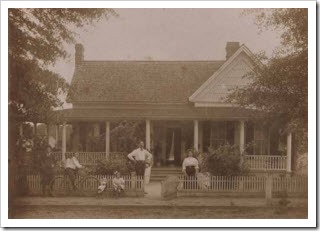
I found the photo above by browsing the Houses category.  When you view the photo, there are additional details such as a description, time period, subject listing, and where in the archives collection the photo is located.

There’s some interesting items in the digital collection, so if you have Alabama roots, you should certainly check it out!


Genealogy By the States is a theme created by Jim Sanders over at the Hidden Genealogy Nuggets blog.


Share/Bookmark

Thursday, May 30, 2013

Genealogy By the States – Week 21 – Illinois

Illinois

Between me and my husband, there are many relatives associated with many places Illinois. 

map

My mind was spiraling out of control with the many things I could write about for this post. Ultimately I decided to share my growing list of online resources.

I’ve shared in the past that I use a bookmarking site called Diigo to manage all of my genealogy bookmarks (you can read more here and you can also check out the guide I developed here).  The Illinois Genealogy list is my largest locality-specific list.  It contains all sorts of resources that I use all the time in my own research.  Maybe some of them will help you too!  Be sure to check back often or follow the RSS feed as I am always adding to it.


Genealogy By the States is a theme created by Jim Sanders over at the Hidden Genealogy Nuggets blog.


Share/Bookmark

Thursday, May 23, 2013

Genealogy By the States – Week 20 – Mississippi

Mississippi

Not one person in my database has ties to Mississippi.  So off to my Diigo bookmarks to see what resources I had for Mississippi.  Only a few, but one seemed pretty interesting.  It’s called Mississippi History Now, which is an online publication of the Mississippi Historical Society.

There are a variety of articles covering an array of topics.  You can browse or search the articles.  They are even broken down into topics, such as Civil War and General History.  Want to learn more about Mississippi when it was under British rule?  There’s an article for that.  What about catfish farming?  There’s an article for that too, along with a recipe for fried catfish.

It’s a pretty neat site…I encourage you to explore it at your leisure!


Genealogy By the States is a theme created by Jim Sanders over at the Hidden Genealogy Nuggets blog.


Share/Bookmark

Thursday, May 16, 2013

Genealogy By the States – Week 19 – Indiana

Indiana

I actually do have several people in my database associated with Indiana.  Most of them are very distant relatives or related to my husband.  But one family is that of a great-grandaunt, who left Illinois and lived in Michigan, Ohio, and Indiana.  It’s a very tangled web, one with multiple marriages and questions of paternity.  While I think I have most of the story figured out, there is still some work to be done. 

I thought I’d share with you some of the online resources that have been helpful in my quest.  I know this week is about Indiana, but the family I’m working with was situated in places in Michigan and Ohio that were near Indiana so I’m including those resources as well.

map1


Genealogy By the States is a theme created by Jim Sanders over at the Hidden Genealogy Nuggets blog.


Share/Bookmark

Wednesday, May 8, 2013

Genealogy By the States – Week 18 – Louisiana

Louisiana

Unfortunately I have absolutely no connection to Louisiana (except for some friends who moved there last year, fitting since they’re huge Saints fans!).  So this week, I implore you to check out a post that Miriam Robbins put together back in 2010 entitled 52 Weeks of Online American Digital Archives and Databases: Louisiana.  There are a lot of great resources to peruse!


Genealogy By the States is a theme created by Jim Sanders over at the Hidden Genealogy Nuggets blog.


Share/Bookmark

Thursday, May 2, 2013

Genealogy By the States – Week 17 – Ohio

Ohio

I do have a few ties to Ohio, and thanks to the various record collections available through FamilySearch, I was able to make this discovery. 

If you have family in Ohio, I highly recommend using the record collections at FamilySearch.  There are so many wonderful records for Ohio including death records, birth records, and marriage records.  I even came across Interment Registers for Cleveland, which helped me with a pre-1908 death.  They’re even adding probate records, although not all counties are available yet.

In addition to the FamilySearch records, there are many other resources available online.  You can take a look at what I’ve found over the years at my Ohio Genealogy collection on Diigo.


Genealogy By the States is a theme created by Jim Sanders over at the Hidden Genealogy Nuggets blog.


Share/Bookmark

Thursday, April 25, 2013

Genealogy By the States – Week 16 – Tennessee

Tennessee

No major ties to Tennessee except for one of my husband’s families that lived in Tennessee for a few years after the Civil War.  So for this post, all I really have to offer is a few links to some online Tennessee resources.


Genealogy By the States is a theme created by Jim Sanders over at the Hidden Genealogy Nuggets blog.


Share/Bookmark

Thursday, April 18, 2013

Genealogy By the States – Week 15 – Kentucky

Kentucky

I’ve been trying to learn a little more about my husband’s Williams family who lived in the area of Kentucky where Caldwell, Christian, and Hopkins counties meet. 

Back in December 2011, I learned the name of his great-grandparents, James Pearl WILLIAMS and Norma Ola “Nola” BOYD.  I then found an index entry for their marriage in 1905 in Christian County.  And in February 2012, I retrieved their marriage record while I was at the FHL.1

Pearl Williams Marriage Record

Today, I found a marriage announcement in the Hokinsville Kentuckian at Chronicling America.2

Pearl Williams Marriage Annoucement

I know from Pearl’s death certificate that his parents were given as James WILLIAMS and Lou DUNNING.  Unfortunately, I have not been able to find anything on them in the censuses (Pearl would likely be living with them in 1900 as he didn’t marry until 1905—but I can’t find them!).

Working with the name James Williams across three Kentucky counties is not easy.  But today, I managed to find a marriage index entry on Ancestry for a James Williams and a Luwandy Dunning, who married in 1873 in Hopkins County.  Seems promising; Luwandy could equal Lou, right time, right place.  So I plan to obtain a copy of the marriage record and see what clues it might hold.

Making progress!

Sources

1.  Christian County, Kentucky, Christian County Marriage Records, 1797-1971, 16: 28-29, Williams-Boyd; FHL microfilm 1,942,960. 

2.  "Williams-Boyd, Young People of Near Empire Married This Week," Hopkinsville Kentuckian, 2 September 1905, p. 2, col. 2; digital images, Chronicling America (chroniclingamerica.loc.gov : accessed 16 April 2013), Historic American Newspapers.


Genealogy By the States is a theme created by Jim Sanders over at the Hidden Genealogy Nuggets blog.


Share/Bookmark

Thursday, April 11, 2013

Genealogy By the States – Week 14 – Vermont

Vermont

I’ve written about my Norton family from Vermont several times on this blog.  So instead of writing more about this mysterious family and what I don’t know, I thought I’d share something I found among the family papers in my possession.

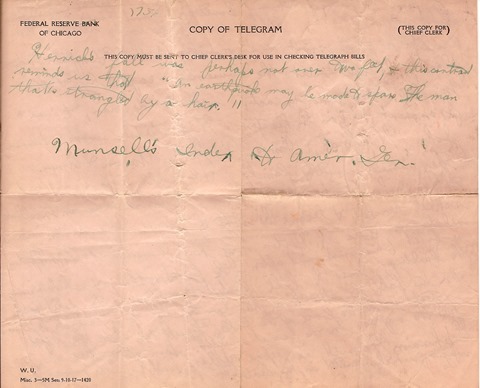
The two images below were written by an unknown person.  Since they were among my family papers, I suspect it was a family member, and there is one clue as to who it might have been.  In the second image, we can see that the paper was from the Federal Reserve Bank in Chicago, and wouldn’t you know, my great-granduncle Joseph Webster Garrison worked at that bank.  Hmm…could he have written this?  He was the family historian in his day, it just might have been him!

NORTON Family History Notes 01

NORTON Family History Notes 02

And what is it exactly that is written?  Well, it’s a copy of the biography of Solomon Norton found in the book A History of the Town of Poultney, Vermont, From Its Settlement to the Year 1875, published by J. Joslin, B. Frisbie, and F. Ruggles.  It reads:

Solomon Norton was one of the early settlers.  He built the first grist and saw mills at the Hampton bridge place; he also built the house now occupied by F. W. Moseley.  He was an active well-to-do man, and was a prominent citizen in his time.  His children were: Solomon, John, Hannah, James R., Joel, Aaron and Amos.  They were a worthy family, but all long since ceased to be inhabitants of the town.  Hannah was an excellent school teacher, and became the wife of Zimri Howe.  An instance relating to James R. Norton may here be mentioned.  Mr. Norton re-built his grist mill after the flood of 1811; and while raising the building, James R. fell forty-two feet onto solid rock.  In his fall he struck a man on the way down, which to some extent broke the force of the fall.  The next day he helped out the rafters on the same building.  Soon after this, Ephraim Herrick, as before appears, had a fall from a wagon, which resulted in his death.  Herrick’s fall was perhaps not over two feet, and this contrast reminds us that “An earthquake may be made to spare The man that’s strangled by a hair.”


Genealogy By the States is a theme created by Jim Sanders over at the Hidden Genealogy Nuggets blog.


Share/Bookmark

Thursday, April 4, 2013

Genealogy By the States – Week 13 – Rhode Island

Rhode Island

Another state in which I have no family ties, however, my husband does.  Hubby’s third great-grandfather, William Lindsey lived in Smithfield, Providence Rhode Island, for a time before relocating to Illinois by 1860. 

I don’t really know a whole lot about William, his wife Hannah, or their children.  It looked as though two of their known children were born in Rhode Island, so I though I’d check out the various records and indexes on FamilySearch to see what I could dig up. 

While the birth index was a bust, I tried the marriage index and found an index entry for an Emma Lindsey (father William) and a Matilda Lindsey (father William).  Both marriages occurred in Smithfield within three days of one another, and both women married men with the surname Northup, who appear to be brothers (father for both is listed as Sylvester).  Matilda married Charles F, and Emma married Nathaniel C.  The woman married in 1849 and would be about the right age to fill the large gap I have for William and Hannah’s children.  This would also explain why there was no mention of Emma or Matilda in the 1850 census household of William.  This is of course not to say that either are the daughter of the William in question, but it is highly suspect and worth investigating further.

The connection to Emma and William is even stronger, given that an Emma and Nathaniel are buried in the same cemetery in Knox County, Illinois, as William, Hannah, and their son John.  Although William and Hannah have moved to Illinois by the 1860 census, Emma and Nathaniel are still in Rhode Island.  I was unable to find them in subsequent censuses in the short time I searched to write this Rhode Island post.  And it was quite a coincidence that I even found them listed in the Knox County cemetery (I guess having Ancestry link to Find A Grave in their search is kind of a good thing!).

Certainly more research needs to be conducted.  But in just a little over an hour, I was able to find a few additional clues that might help put this family together and may have just added additional children that were previously unknown.  Only more research will tell.


Genealogy By the States is a theme created by Jim Sanders over at the Hidden Genealogy Nuggets blog.


Share/Bookmark

Thursday, March 28, 2013

Genealogy By the States – Week 12 – North Carolina

North Carolina

My husband’s family has ties to North Carolina, although I haven’t done much research on them or in the state.  I decided to do some more digging on the Boone family.  Although I couldn’t find any records in the few hours I searched, I did manage to locate a few mentions in family trees around the internet that are providing some additional clues I didn’t have previously.  But the gem that I found actually comes from my neck of the woods in Illinois: a newspaper article in the Canton Daily Ledger from 1908.

First and foremost, I was ecstatic when I saw that Cornelia BOONE, daughter of Martin Alexander BOONE and Eliza SMITH, named my husband’s second great-grandmother as her sister.  Finally, something tying Eliza Anna Matilda BOONE to her parents besides one measly census record (1880) when she was two years old and then poof!, the family is spread out all over the place by 1900 and I never see her with her parents again.

Second, I love that the person who posted it (Jody) also made note of the line in the article that stated that Cornelia was related to THE Daniel Boone.  Although I haven’t done a ton of research on this family, what I have found does not put them in the Daniel Boone family.  Jody says she has yet to find a connection, so I’m glad to see I’m not the only one that disagrees with the family lore.

But beyond these two things, this article provided a glimpse into Cornelia’s childhood in North Carolina during the Civil War.  I’ve included an excerpt here, as it was transcribed at Surname Site by Jody.  The next time I’m in Canton, I’ll have to swing by the library and get my own copy.  But I do very much appreciate Jody for transcribing and sharing this…I may not have found it for quite some time.

Excerpt from an article in the Canton Daily Ledger, 29 April 1908.

"I was born," said Mrs. Cornelia Simpson, "in Stanley county, N.C., Sept. 13, 1850 and am the daughter of Martin and Eliza Boone, both natives of North Carolina. My father was related to Daniel Boone, the noted pioneer hunter of Kentucky.

"I am the oldest of a family of 11 children, seven of whom, besides myself, are living, namely: Lewis Boone, a resident of North Dakota; Mrs. Malinda Hagena in Colorado; Alex Boone, at Council Bluffs, Iowa; Brady Boone, at Neola, Iowa; Frank Boone, on a farm near Shelby, Iowa; Elmer Boone , in Montana; Mrs. Anna Haacke on a farm in Buckheart township.

"I was about 14 years of age when my parents moved from North Carolina to east Tennessee, where we lived for four or five years, when we came to Illinois.

"We lived in North Carolina during the war. Our house was back in the timber from the road. Father was in the Union army as a scout and guide and I remember when about 30 Confederate soldiers came to the house looking for him. He deserted from the rebel army and joined the Union forces and had they found him they would have shot or hanged him.

"My uncle, who lived near us, slept under his barn floor for six months--in fact, lived there. The rebels often visited his place and searched for him but he got into the Union lines before they caught him.

"My mother and Aunt Nellie Boone farmed our place for three years and I have worked many a day in the fields. Mother and aunt sowed and cradled wheat and helped to thresh it. The women operated and fed the old ground threshers, ran the water mills, etc. The women and old gray-headed men did all the farm work and got along pretty well, everything considered.

"At first we had to give a tenth of everything we raised to the Confederate government, but later a fifth and finally a third.

"One old man who ran a thresher had his three girls with him, and they all worked early and late. The women of the south, especially those whose husbands and sons were in the Union army, had a hard row to hoe. Women whose eyes were as bright and whose forms were as erect as in the days of their girlhood when the war broke out, were bent with care and work and troubled at its close, and their heads were covered over with the snow that never melts. Their last thoughts at night, as they wafted their prayers to the throne of God, asking him to care for their loved ones, and their first thoughts in the morning, were for their husbands and sons. Mothers, wives, sisters and daughters suffered in silence and God alone knows how much they suffered and what trials and dangers they passed through.

"Oh, but I can never forget the old civil war days in the south, notwithstanding I was but a child.

"We lived just five miles from the line between North and South Carolina and I often went on horseback to Bradaway's mill on the river between the two states. Sometimes I took my grist of corn to Meggs' mill, on the same stream.

"There were no buggies in the south in those days and we all rode in wagons.

"There were a good many slaves in Stanley county before the war and many of them did not know their own Master. They were put in charge of an overseer and worked in the fields from early morning until late at night. Their time was given to them from Saturday noon until sunrise Monday morning--and such times as they did have, singing, dancing, playing the banjo and the fiddle!

"The poor people wore cotton or homespun clothing and often went to church barefooted. The women wore calico sunbonnets.

"The poor white people in the south before the war enjoyed life better than did the slaveholders. The agitation of the slavery question and the growing sentiment against human bondage, not only in the north but all over the world, were thorns in the sides of the slave owners.

"A part of the troops raised in Stanley county were drilled in a big field near our house and we often saw large bodies of Confederate soldiers pass and repass. It was their boast that they would soon whip the Yankee, it would only be 'a breakfast spell'--but the conflict proved to be one of the greatest in history and lasted till after dinner--in fact, till nearly supper time. Everything hinged upon the result of that war, but peace came and the nation was saved.

"The happiest days of my life were spent in the old North Carolina and Tennessee homes, but our days during the war were not happy ones. Many times did I lean my arms on the window sill while mother was preparing the evening meal and look far into the dusky shadows that encircled the brow of night; but papa did not come.


"Oh, we were never free from the tortures of anxiety about the absent ones, and we often went to bed with heavy hearts. Why should the slaveholders cause sorrow and death to overspread our fair land, and the voice of waiing go forth from every fireside? The hours were long and dark, but peace came at last--thank God!--and came to stay, so far as the north and south were concerned.

"A few of the old slaveholders and their descendants will never be satisfied with the result. The people of the south--I mean the common people--were in antebellum days more sociable than the people of the north and would often congregate together and have a general good time. As things were then, I would rather live in the south than in the north.

"There were many good people among the slaveholders, and there were some bad ones, too.

"We practically abandoned our old homestead in North Carolina, because we could not sell it, and went to east Tennessee, about the time the war closed. The Union sentiment in east Tennessee was pretty strong and many Union refugees found a home there after Lee's and Johnston's surrender."



Genealogy By the States is a theme created by Jim Sanders over at the Hidden Genealogy Nuggets blog.


Share/Bookmark

Thursday, March 21, 2013

Genealogy By the States – Week 11 – New York

New York

Part of the reason I took on the Genealogy By the States challenge is because I knew it would force me not only to post something every week, but it would allow me to get in some research time.  Only 11 weeks in and I have made some great discoveries that I may never have gotten around to.  This week was no different. 

I have lots of New York connections so my initial problem was figuring out who or what to tackle.  I ultimately decided to explore the New York Land Records, 1630-1975 image collection that was added to FamilySearch a few months ago.  What a relief to be able to explore the many counties I needed to search (just for one family!) from the comfort of my home.  I cannot begin to tell you how many films I would have had to order just to research this one family, not to mention the other families I have in New York. 

Part of the reason so many counties were involved is because this particular family lived in three different areas in New York, and during the times they were in a county, new counties were being formed.  Thank goodness for Red Book and the thoroughness of information on county formations and records.  And fortunately, I had kept excellent notes on the specific towns and the trail of counties the belonged to and when.

After searching all but one of the applicable counties, I found three deeds that were relevant to my research goal of finding land records for Aaron Webster in known places of residence in New York.  Oddly enough, each of the three are the selling of land and I was not able to find the initial purchase for any of them.  The good news is I have a better timeline to work with, which will be helpful for continued research on this family.

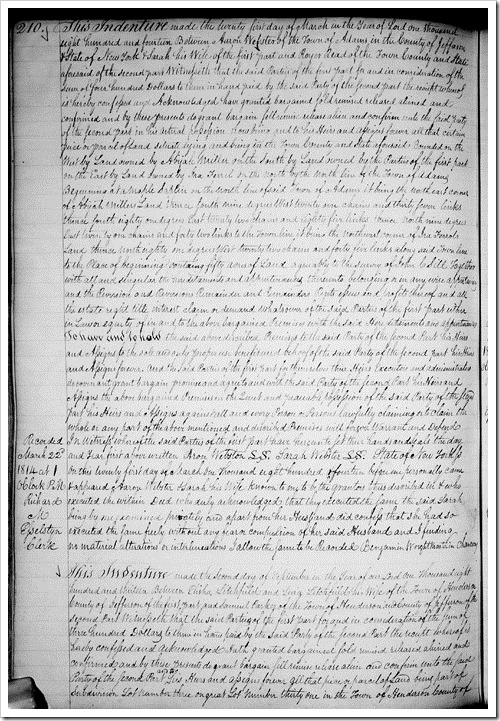
Below is one of the deeds I found in Jefferson County.1

Aaron WEBSTER Deed

Click image to see the original on FamilySearch.

Another interesting resource I found was The Balloting Book, and Other Documents Relating to Military Bounty Lands in the State of New York (this was found under Onondaga County).  This book lists all of the townships (including those outside Onondaga County) and who was awarded each lot of land.  It also lists each person and whether they were actually deeded the land or if they assigned it to someone else.  For more information about the Military Tract of Central New York, see the Wikipedia entry for Central New York Military Tract and information put together for the Cayuga County NYGenWeb Project entitled A Summary History of the Military Tract of Central NY.

Even though this resource didn’t really apply to what I was working on (or any of my ancestors, that I’m aware of at this point in time), I thought maybe I could figure out who was awarded Lot 47 in Fabius that Aaron acquired and later sold in 1806.  I hoped that I could follow the trail and perhaps find the deed where Aaron purchased the land, thinking perhaps it wasn’t indexed correctly or at all under Aaron as the grantee. 

I was able to figure out that Thomas Warner, Lt. was awarded Lot 47 in Fabius and assigned it to Richard Platt.  This was verified by the deed index showing the transaction for that land from Thomas Warner to Richard Platt (however, I cannot locate the actual record).  Unfortunately, I could not find a record of Richard Platt ever selling that land.  On top of that, in the handwritten pages after the book, there are other names listed for Lot 47 in Fabius:  William Cooper and Seth Johnson.  This was further confirmed by the Awards of the Onondaga Commissioners book.  I’ll have to work on this further and see what shakes out.

My focus was on Aaron Webster’s land transactions in New York, but while I was searching the indexes, I also noted other Websters I knew were in the same areas.  So now I have a list of other deeds I need to pull and work on in the future.  My next step in Aaron’s project will be to transcribe the three deeds I found and adjust my visual timeline accordingly.  Those “unknown” gaps of time are getting smaller!!


Sources

1.  Jefferson, New York, Deed Records, F: 210, Aaron Webster to Roger Read, deed, 21 March 1814; digital images, "New York, Land Records, 1630-1975," FamilySearch (familysearch.org : accessed 20 March 2013).


Genealogy By the States is a theme created by Jim Sanders over at the Hidden Genealogy Nuggets blog.


Share/Bookmark

Thursday, March 14, 2013

Genealogy By the States – Week 10 – Virginia

Virginia

I don’t have too many ties to Virginia, but I thought I’d take some time and write about a cousin who ended up in the National Home for Disabled Volunteer Soldiers, Southern Branch in Hampton, Virginia.

Phineas D Parks is my first cousin five times removed.  He is the son of Calvin Chapin Parks and Harriet Thomas.  He was born about 1833 in Oakland County, Michigan Territory.  By 1850, he was living in Waukegan, Lake, Illinois.  On 5 November 1856, Phineas married Harriet Lincoln in Kendall County, Illinois, and by 1860, they were living in Earl, LaSalle, Illinois, with their infant daughter, Hattie.

On 26 September 1861, he enlisted in Company I, Illinois 4th Cavalry as a Sergeant.  He was discharged on 8 July 1862 due to disability, rank of QM Sergeant.

Eventually, I find Phineas living in the National Home for Disabled Volunteer Soldiers, Southern Branch in Hampton, Virginia by 1880.  How or why he ended up there, I’m not sure.  He died on 7 June 1891, at the home, and is buried in Hampton National Cemetery.

According to the National Home records, he was admitted on 17 April 1879.  From then until March 1883, it looks like he was in and out of the home, either by transfer to and from the Northwest Branch, or discharged and readmitted.

Historical Register of National Homes for Disabled Volunteer Soldiers, 1866-1938, Southern Branch, Page 1
PARKS, Phineas D PARKS US National Homes Register page 1
Historical Register of National Homes for Disabled Volunteer Soldiers, 1866-1938, Southern Branch, Page 2
PARKS, Phineas D PARKS US National Homes Register page 2

Where Phineas was between the time he was discharged from service and when he appears in the Home in 1879, I’m not sure.  I find a P D Parks (widow, age 37, born in Michigan) and a Hattie (age 10, born in Illinois), living in Seattle, Washington.  By all appearances, this would seem to be Phineas and his daughter Hattie.  But, I’m not 100% sure.  The occupation of lawyer throws me off, since he identified himself as a dry goods merchant in 1860 and a tinsmith in 1880.

I also found an Army enlistment record for a Phineas D Parks, enlisted on 5 August 1864 at Chicago, Illinois.  He’s the right age and lists Oakland County, Michigan as his place of birth and tinsmith as his occupation.  The “Remarks” column has a bunch of information, most of which I don’t understand, but I can clearly read the last two words, which say “a Private.”  Military records, terminology, and protocol, are clearly not my area of expertise, but if this is the same person, how can he go from the rank of a Sergeant to a Private?  I’m also not sure how he could re-enlist after being discharged for disability (the 1890 census Veterans Schedule indicated his disability as “sabre wound head”).  Plus, the dates of enlistment and discharge that he uses for the Home register and the 1890 census Veterans Schedule, are the dates from 1861 and 1862.  There is no mention in the Home register of additional service, not that there would be (remember, me + military records = not good!).  But curiously, there is mention of additional Navy service in the 1890 census.

It appears he filed for a pension in 1879.  Perhaps the file would shed more light on not only his military service, but where he was in those intervening years.

Genealogy By the States is a theme created by Jim Sanders over at the Hidden Genealogy Nuggets blog.


Share/Bookmark

Thursday, March 7, 2013

Genealogy By the States – Week 9 – New Hampshire

New Hampshire

I have some distant ties to New Hampshire, one of them being my seventh great-grandaunt, Esther Webster, daughter of Jonathan and Esther (Judd) Webster.  Esther married about 1724, Timothy Smith, son of Samuel and Mary (Smith) Smith.  Sometime in the 1760s, Esther and Timothy settled in Hanover, New Hampshire.

Not much work has been done on this family and the framework was built from the Webster genealogy.1  Unfortunately, I don’t have too much time to dedicate to this family right now, but I did do a little digging and found some sources that I have added as “need to review” to my to-do list.  Perhaps they will be of help to you if you also have Hanover, New Hampshire ancestors.

From what I’ve learned, just briefly looking through these sources, Timothy Smith was involved with the founding of Dartmouth College.  The Hanover town records indicate that he contributed 100 acres of land.  I’m not sure if he was involved any further than that, but hopefully one day I’ll find out.  So I’ll close this post with a sketch of Dartmouth College, found in the book A History and Description of New England, General and Local on page 518.

Dartmouth


1.  William Holcomb Webster and Rev. Melville Reuben Webster D. D., History and Genealogy of the Gov. John Webster Family of Connecticut With Numerous Portraits and Illustrations (Rochester, New York: E. R. Andrews Printing Co., 1915)

Genealogy By the States is a theme created by Jim Sanders over at the Hidden Genealogy Nuggets blog.


Share/Bookmark

Thursday, February 28, 2013

Genealogy By the States – Week 8 – South Carolina

South Carolina

No ties to South Carolina for me.  That being the case, I decided to just poke around the South Carolina Digital Library (SCDL).  SCDL is a portal to online digital collections held by institutions in South Carolina.  There are a variety of collections including full-text books, maps, photographs, manuscripts, and newspapers.

Taking a stroll through the various collection, I found something I’d never seen before.  A certificate of departure from the year 1812.  This particular certificate is for Nathanial Heyward from Charleston, South Carolina.  He was traveling from Liverpool to Boston, departing on 18 July 1812.  This document is part of the Heyward and Ferguson Family Papers, 1806-1926 collection held by the College of Charleston Libraries.  You can see the original image here.

SCDL1

Even though I have no connection to South Carolina, I was fascinated with all the neat stuff I found in the South Carolina Digital Library.  I could have browsed for hours!  If I ever do find South Carolina roots, this will certainly be one of the first places I check out, particularly because of the map collection.  If you have South Carolina folks in your family tree, I highly recommend that you take a look at this resource.

Genealogy By the States is a theme created by Jim Sanders over at the Hidden Genealogy Nuggets blog.


Share/Bookmark

  © Copyright 2008~2013. All rights reserved.

  © Blogger template 'Minimalist E' by Ourblogtemplates.com 2008

  Social media icons are from GraphicsFuel.com

Back to TOP  

Related Posts Plugin for WordPress, Blogger...