Picture

Picture

Monday, October 31, 2011

I’m Now the Proud Owner of…

Well, Happy Halloween to me!  Boy did I get a treat!
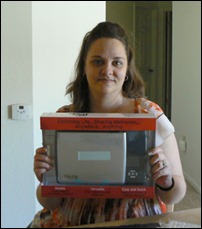
As I was coming home today, the UPS guy was right behind me and I knew he was going to follow me home…and he did…with my new Flip-Pal™ Mobile Scanner in hand!

I was selected as one of a handful of bloggers to participate in the Simple Gifts Blog Hop, which will run November 4th - 25th.  During this time I will be documenting how I used this neat little gadget to create genealogy-related gifts.  I have a few projects in mind and can’t wait to get started!

Want to know how others are using their Flip-Pal™ Mobile Scanner?  There are six other bloggers who are participating in the Simple Gifts Blog Hop, so hop on over and check ‘em out.
 

Disclosure:  I was selected to participate in this project and by doing so I received a Flip-Pal™ Mobile Scannerto evaluate.

Share/Bookmark

Friday, October 28, 2011

Friday Finds – 10/28/11

Weekly column sharing genealogy-related things that I’ve found.

New-to-Me Blogs

Online Articles/Posts

Print Articles

  • Nothing to share this week

Websites


Share/Bookmark

Friday, October 21, 2011

Friday Finds – 10/21/11

Weekly column sharing genealogy-related things that I’ve found.

New-to-Me Blogs

Online Posts/Articles

Print Articles

  • “First-Rate Second Life,” by Tami Osmer Glatz, Family Tree Magazine, September 2011 (Thank you Tami for this article.  This is something I had been considering for awhile now and you’ve given me the motivation to go for it!)

Websites


Share/Bookmark

And All the Stars Aligned

It has been one heck of a week, okay more like one heck of a couple of months, but I digress.  But amidst the chaos, I did experience serendipity.  One by one the stars aligned and led me to quite the discovery.  It’s a mystery I knew I’d solve one day, but figured it would take a tremendous amount of time and research in facilities and records that are not exactly nearby.  But in a strange twist of fate, there it was.

The Back Story

Barbara is a cousin of mine and we met in early 2008 when she emailed me about a common ancestor, Philip Rottman.  We exchanged a few emails and then lost touch until June 2010.  We converse here and there about our Rottman clan periodically through Facebook, trying to learn more about Philip and his wife Mary Eva.  Neither of us has had much luck on this front.

The Stars Begin to Align

The other day, Barbara posted a note on my Facebook wall about a possible passenger ship record for Mary Eva.  Several comments were exchanged, one of which was the following (in part)  from Barbara: 

“…Aunt Anna always said her father told her that Phillip left the family and went to Colorado where he died in a bar fight...He had asked Mary Eva to go with him, but she refused...just a family story, but it may have a hint of truth….”

My response was:

“In my grandmother's notes, there is a mention of Golden, Colorado by his name...the story could very well have some truth to it.”

Here I had someone else mention Colorado, so now I’m working with the assumption that the reference my grandmother made about her grandfather and Golden, Colorado had to mean something.

On Wednesday night, I was reading the September issue of Family Tree Magazine and checking out their top 101 website list.  Listed was Colorado Historic Newspaper Collection.  Now mind you, I’ve known about this possible connection to Colorado for years and I have checked for death records and online newspapers in the past, but this website seemed new to me, and since Barbara and I were on the subject of Philip and Colorado, I made a note of the website.

Last night, I was checking out some of those 101 top websites and came to the Colorado newspaper one.  I did a quick search for Rottman, Rotman and Rothman (all with double “n” too) and got nothing.  Not knowing how good the OCR search was, I decided to browse by newspaper.  I looked at the newspaper in Golden and the ones in Denver, but none of them had the time period I was looking for.  Bummer.

All Hope is Not Lost

I then wondered if I had ever searched GenealogyBank for a newspaper article.  I was sure I had, but they add new stuff all the time.  Something told me to go there and search again.  I did a search for Philip Rottman and a bunch of New Jersey papers came up.  And just as I was about to throw in the towel and get back to what I had previously been doing, I saw it:  an 1885 article in a Denver newspaper.  I just knew it had to be him, right?

I start reading the article.  It seemed promising.  The man was a “stranger” and fell out of a window to his death.  Blah, blah, blah, they don’t know him, his son is there, yaddy-yadda…it seems like this is going nowhere and that there will not be enough information to determine if this is MY Philip.  Then I get to the last paragraph, it starts:

“During the day something was learned of the man.  His name was Philip Rothman and he came from Lisbon, Iowa…”

Mind you, the opening paragraph included his name (the surname was spelled Rottman).  Why it took to the last paragraph of a fairly lengthy article to get to this, well I’m sure the foresight was to annoy me some 120 years later.

Anyway, I knew from that second sentence, this was without a doubt, my Philip Rottman.  The article goes on to talk about his wife, whom he was separated from, and children, suggesting that part of what Barbara has heard was in part, true.

Then, to add even more dancing to the already super-happy dance, it mentions that “he has a mother living at Lisbon, Iowa, who is about 75 years of age.”  Seriously?  While a name would have been nice, just that fact that his mother apparently immigrated to the US, was 75, and living in Lisbon is certainly a huge step forward in learning more about this family.

Another Moral This Week

Even though I was focused on several other things this week, and not really working on this family, something pulled me in a different direction, namely, cousin Barbara.  Then the events followed they way they did in a nice, neat package.  It just goes to show you that things really do happen for a reason.  And, when life hands you a box of chocolates, you better stop what you’re doing and open it…you never know what you might get!

A PDF version of the newspaper article can be read here (I hope, I always seem to have problems with Google Docs).


Share/Bookmark

Thursday, October 20, 2011

Hello, My Name Is… Part 2

Earlier I posted Hello, My Name Is…  Part 1.  In that post I talked about a blog post written by Lynn Palermo and a Facebook comment from Kerry Scott.  In a nutshell, both had to do with letting the world know who you are on your genealogy blog.  Lynn’s was general in nature while Kerry’s was targeted toward professional genealogists.  My previous post focused on genealogy bloggers in general; this post will look at professionals.

There are plenty of professional genealogists out there, but sometimes it’s hard to find one.  And to be fair, for those people who are just starting their family history journey they probably don’t know there is such a thing as a professional genealogist, much less where to find one.  Regardless, the first place many people go to learn more about a subject is the internet (and if they don’t use a computer, they ask their kids or grandkids to look into it on the internet for them).  With that being the case, professional genealogists should have some sort of web presence if they want to generate business.

These days, a web presence can mean different things.  It used to be simply a website.  Now a web presence could also include a blog, a Facebook account and/or page, a Twitter account, a LinkedIn account, or a variety of other social media and networking tools.  While these tools have their place, this post is only concerned with the website and blog aspect.

You would not believe how many professional genealogists do not provide their name on their website/blog.  I had made this observation before reading Kerry’s Facebook comment, but never gave it much thought other than “well, I don’t know who you are, so I’m moving on.”  Did you hear that?  I’m moving on.  That’s right, your potential client just walked out of your store, so to speak, never to return, all because you wouldn’t identify yourself.

I realize that people want to be cautious when putting information on the web.  I can understand how as professionals who work from home, we don’t want to have our home phone number and address plastered everywhere.  There are of course alternatives to that such as PO boxes and a separate phone number, but both require an additional expense.  But at a minimum, you should provide your name (first and last), a short bio, the services you provide, and an email address so prospective clients can reach you.  Whether you have a blog, website, or both, you need to be accessible to potential clients.

Here’s an example.  The other day, I visited the website of a professional genealogist, whose business card I picked up at the FGS conference.  It was a nice website, the design was pleasant, there was a list of services and upcoming lectures, and a contact form.  Now, there was an “about me” page, however, nowhere on the site do you see her name.  The only reason I knew who it was is because I had her business card.  Do you see the disconnect here?  If I had come to her page without knowing her previously, I would have walked away pretty quickly.  And let’s face it, those potential clients are likely to find you on the web before they’d ever see your business card.

As the comments on Kerry’s Facebook comment ensued, there was also mention about the blog and website being one-in-the-same.  Personally, I don’t care how you do it, so long as wherever I am, I know who you are, what you can do for me, and how I can contact you. 

Following are some good examples of a professional genealogy website.  They all include information about the person(s) in business, the services/products offered, and a way to contact them.

And of course, my blog/website, Writing Your Way to the Past (hey, it’s my blog, I can do cross-promotion!).

For those of you who are living a life of online anonymity as a professional genealogist, I do hope you’ll consider making some changes to your website and/or blog to become more accessible to your potential clients.  It’s acceptable to lose a potential client because you cannot fulfill their research needs, or lack a certain specialty, or heck even because your services cost more than the person can spend.  But it’s not okay to lose a client simply because you won’t put your name on your website.


Share/Bookmark

Hello, My Name Is… Part 1

Name Back in late August, Lynn Palermo wrote an article entitled, New Genealogy Bloggers…Who Are You?, where she essentially challenged new all genealogy bloggers to, at a minimum, include their name somewhere on their blog.  Ultimately Lynn pleaded with genealogy bloggers to have an “about” page that tells their audience a little bit about themselves.  Her advice was general in nature and applied to all genealogy bloggers.

The other day, Kerry Scott, of Clue Wagon, posted the following comment on Facebook:

Clue: Unless you are independently wealthy or otherwise don't want anyone to ever hire you for anything genealogy-related, your blog needs to list your real first and last name. It also needs to have enough information about you so that I can decide whether you know enough about a genealogy-related topic that I might want to hire you. … I've been recruiting for 15 years, and this is the only field I know of where people work so hard to be un-hireable. Opportunity cannot knock if you barricade the door. Sheesh!

Kerry’s comment was geared toward professional genealogists who have blogs.  Both of these wonderful gals make some great points, but I’d like to take each a step further.  This first post will focus on genealogy bloggers in general.  In the second post I’ll turn to the professional genealogists who have a blog and/or website.


As researchers, it’s important for us to be accessible, especially when we publish our work, regardless of the media we use.  By creating a genealogy blog, you’ve already decided you want to share your research or family stories, whether with family or the world.  And blogging is a great way to accomplish this since it’s free, easy, published on your timetable, and far-reaching.

Think for a moment:  If you were to publish one of these research stories in a society journal, you would certainly use your real name and a valid email address, wouldn’t you?  Of course, you would, so why should your blog be any different?  You need to provide a way for people (whether long-lost cousins or fellow researchers) to know who you are and how to contact you, just like you would if you were publishing the research in a traditional publication.

Let me illustrate it another way.  I have been blogging for over three years now, and in that time I’ve had several people contact me through my blog.  In one instance, a cousin who I had not seen in over ten years found me through my blog and emailed me; we’ve been in touch ever since.  In other cases, other researchers have contacted me asking for and/or offering up information pertaining to a family I have blogged about.  I have made several cousin-connections through my blog, simply because I’m out there and ACCESSIBLE!  I shudder to think how different things would be if people hadn’t been able to contact me through my blog.

Conversely, as a researcher who reads other genealogy blogs, I find it frustrating when someone doesn’t provide their name or a way for me to get in touch with them.  Sure, I can leave a comment on a blog post, but who knows who’s behind the magic curtain.  I want to know who you are and how to contact you!  The same applies to websites.  If you’ve created your own genealogy website with all sorts of great information, please tell me who you are and how I can contact you.  You’re doing yourself a huge disservice by not providing this information on your blog or website.  You never know what genealogy mysteries could be solved had you only provided a means of contact!

Bottom Line:  Include your name—first and last—and some way for people to contact you (email address, contact form, whatever) somewhere on your blog (and really, don’t make me waste time searching for it, make it obvious).  I also think a short bio should be available somewhere on your blog, that lets readers know not only who you are, but what your research experience is, what topics you are interested in, and the names and places you are researching.  Blogging is not only a way to share your stories, it serves as a research tool in and of itself.  It’s also a way to connect with other people, which is so important in the research process.

And, I hate to say it, but if you’ve created your blog for the sole purpose of sharing it with family, and therefore don’t really have a need to tell them who you are, then I suggest you make the blog private and add those select people as readers.  But, more importantly, if you decide to leave it “public” but you would rather be invisible, then don’t publicize it…don’t list it with GeneaBloggers, don’t tweet about it, don’t talk about it on Facebook.  There’s no sense in telling the world about your blog when you don’t want the world to know about, or heaven forbid, contact you.  Sorry to be blunt, but it is what it is.

As an aside, I realize people are concerned with privacy issues.  However, it’s no different than being listed in the white pages both in the phonebook and online.  Just be smart and use caution when responding to someone’s inquiry about your family. 


Share/Bookmark

Wednesday, October 19, 2011

Why it Pays to Read the Record Collection Description

A few years ago, I remember searching for my great-grandfather’s World War II draft registration card.  I tried every possible combination I could think of between names, places, and date of birth.  After countless attempts, I gave up and made a note of the search in my database. 

Several months after this, I was working on family in Michigan and was struggling to find the WWII draft cards for these guys.  Then it dawned on me.  My great-grandfather was also living in Michigan at the time and I was unable to find him.  Was this a coincidence?

I was sure it wasn’t a coincidence and figured there had to be a reason, so I looked at the record description that Ancestry has for their WWII draft card collection.  Lo and behold, Michigan was NOT a state that was included in their collection.  Well no wonder I couldn’t find these men…Ancestry didn’t have them!  I made a note of this in my database and added the fact that NARA has the cards in their Chicago facility.

Earlier today, I was checking to see if there were any recently added or updated collections at FamilySearch (I try to do this once a week).  And although the WWII draft cards collection wasn’t new or updated, it occurred to me, why not check to see if they have Michigan.  Ah-ha, they do!  And there was the draft card for my second great-grandfather, right were I expected it to be.

Mind you, FamilySearch has two different collections.  Both collection have images, but one is indexed and the other is not.  Following is a list of the Ancestry and FamilySearch collections and what states they each cover.

Ancestry FamilySearch (indexed) FamilySearch (image-only)
Alaska
Arkansas*
California*
Connecticut
Delaware
Idaho
Illinois
Indiana*
Maryland
Massachusetts
New Hampshire
New Jersey
New York*
Ohio*
Oregon
Pennsylvania
Puerto Rico
Rhode Island
Vermont
Virginia
Washington
West Virginia
Arkansas
California
Connecticut
Delaware
Indiana
Louisiana
Maryland
Michigan
Nevada
New Jersey
New York (NYC, all 5 boroughs)
Ohio
Oklahoma
Pennsylvania
Texas
West Virginia
Wisconsin
Delaware
Illinois
Indiana
Maryland
Massachusetts
New Hampshire
New York (NYC, all 5 boroughs)
Ohio
Pennsylvania
Puerto Rico
Rhode Island
Vermont
West Virginia
Wisconsin

*Collection incomplete for these states

It’s also important to note that WWII draft registration cards were destroyed for the following states:

  • Alabama
  • Florida
  • Georgia
  • Kentucky
  • Mississippi
  • North Carolina
  • South Carolina
  • Tennessee

The moral of the story?  Always read the record collection description.  At a minimum it should tell you what the collection covers, the source of the original information, and why the records were created.


Share/Bookmark

REVIEW: JustaJoy Family Heirloom Exchange

img The concept of JustaJoy Family Heirloom Exchange is a neat idea.  The website, which is a virtual antique shop, was created in order to reunite “orphaned heirlooms” with family.  There is a catch though--the artifact has to be associated with a surname, which is included as part of the artifact’s listing, along with any other pertinent details.  Some artifact descriptions even include a transcription or other relevant historical or family-related information.

There are thousands of neat artifacts, which are listed for sale by antique dealers and individual collectors.  The unique thing about this website is that the artifacts remain searchable even after they’ve sold.  It’s kind of a way to let people know such an artifact exists, and in some cases, the listing description may hold viable clues for family historians.  Although I haven’t found anything (yet) tied to my family, I have found some really neat artifacts, such as:

  • Revolutionary War Pay Receipt for Elisha Walker
  • 1905 Joplin, MO Mourning Letter
  • 1864 Soldier’s Civil War Letter
  • 1869 Index to the Congressional Record (includes Mary Todd Lincoln Pension)

An annual membership costs $20.  With a membership, you have the ability to view all of the artifacts, which includes a detailed description and, if still available for purchase, the price and contact information of the seller.  You also have the ability to list artifacts you’d like to sell.  I plan to list some of my orphan photos in cases where I don’t have enough information to track down family.  Hopefully through this service I can reunite these photos with family.  Another great membership perk is the ability to list up to 20 surnames in your profile.  In doing so, when an artifact is listed that contains a surname listed in your profile, you are notified via email.

JustaJoy differs from traditional auction sites because they do not collect a commission on any sales, nor are they involved in any transaction.  You simply join at the annual membership rate and peruse, buy, and sell at your leisure.  As a buyer, you work directly with the seller (and vice versa).

The website is still relatively new, but continues to grow everyday.  Right now, you are able to search by surname and perform a general search (for example, by item type or location).  But I have it on good authority that the search will be enhanced sometime in the future.

*This review is of my own accord.  I purchased a membership during the FGS conference last month, mainly out of curiosity and for use in reuniting my collection of orphan photos with their families.


Share/Bookmark

Tuesday, October 18, 2011

Man Attempts to Match Revolutionary War Pay Documents to Descendants

Just received the following press release from JustaJoy Family Heirloom Exchange.  Now that I have some things off my plate, I can finally sit down and write my review of this website, which is slated for later this week.

October 17, 2011
For immediate release

Man Attempts to Match Revolutionary War Pay Documents to Descendants

Doug Miller, resident of Santa Clarita, CA, has found a new calling. An avid genealogist with records on his own family back to the 16th century, Miller has long understood the enchantment of the ancestral call, and now he hopes to share the obsession in a very unique way.

For more than thirty years, Miller has collected land grants, steel engravings, conveyance receipts, Revolutionary War pay documents and other pieces of ephemera. These items would be interesting to any collector, but the genealogist in Miller told him that they would especially be precious to family historians. He explains, “Although I always understood that these pieces were desirable, I never really knew what to do with them until I met Joy.”

Joy is Joy Shivar, owner of the JustaJoy.com Family Heirloom Exchange, an indexed website designed to match original antiques and artifacts back to families. “It always seems that the person in charge of distributing an estate is the wrong one and important family items end up in the hands of antique dealers or collectors. JustaJoy.com is designed to alleviate this situation. We call it ‘Antique Hunting in the Family Tree’ for ‘Orphaned Heirlooms’”, she explains.

Besides documents, other items found on the website include pictures, newspapers, advertising pieces, family Bibles, furniture, trophies and other engraved items, yearbooks and much more. JustaJoy.com is currently advertising original items associated with nearly 40,000 families and, according to Shivar, new surname-related items are added nearly everyday by the antique dealers and others who own them. A $20.00 annual membership fee entitles users to full access to all information on each item including the name of the current owner, contact information and the asking price. Buyers and sellers work directly and the site does not charge commissions, buyer’s premiums or final value fees. The site is called an "Exchange" because persons interested in selling simply join the site as a member, all of whom have access to the "Add a new Surname Listing" function.

An important feature of the site is the “Surname Notification” service. Members are automatically notified as new items are added that match any of the names on their personal surname list (up to twenty can be entered). Although sold items remain on the site as a resource, the surname notification is important to interested buyers because there is usually only one of each original item available.

Miller met Shivar at a recent conference of the Federation of Genealogical Societies held in Springfield, IL and as she explained the service provided by JustaJoy.com, he instantly thought of his archive and how valuable his pieces could be to the right descendant.

Miller can picture the joy that an e-mail, associated with one of his items, could bring. “It’s a win-win-win for everyone,” he said, “I’m excited to be a part of it.”For more information on the JustaJoy.com Family Heirloom Exchange visit www.JustaJoy.com or contact Joy Shivar at 704-948-1912 or Joy@JustaJoy.com


Share/Bookmark

Saturday, October 15, 2011

Ancestors’ GeneaMeme

Jill Ball of Geniaus created a new meme related to ancestors, so I thought I’d participate.

The Rules:
The list should be annotated in the following manner:
Things you have already done or found: bold face type
Things you would like to do or find: italicize (color optional)
Things you haven’t done or found and don’t care to: plain type
You are encouraged to add extra comments in brackets after each item

The Meme:

Which of these apply to you?

1.  Can name my 16 great-great-grandparents
2.  Can name over 50 direct ancestors
3.  Have photographs or portraits of my 8 great-grandparents
4.  Have an ancestor who was married more than three times
5.  Have an ancestor who was a bigamist
6.  Met all four of my grandparents
7.  Met one or more of my great-grandparents
8.  Named a child after an ancestor
9.  Bear an ancestor's given name/s
10.  Have an ancestor from Great Britain or Ireland

11.  Have an ancestor from Asia
12.  Have an ancestor from Continental Europe
13.  Have an ancestor from Africa
14.  Have an ancestor who was an agricultural labourer
15.  Have an ancestor who had large land holdings
16.  Have an ancestor who was a holy man - minister, priest, rabbi
17.  Have an ancestor who was a midwife
18.  Have an ancestor who was an author
19.  Have an ancestor with the surname Smith, Murphy or Jones
20.  Have an ancestor with the surname Wong, Kim, Suzuki or Ng
21.  Have an ancestor with a surname beginning with X
22.  Have an ancestor with a forename beginning with Z
23.  Have an ancestor born on 25th December
24.  Have an ancestor born on New Year's Day
25.  Have blue blood in your family lines
26.  Have a parent who was born in a country different from my country of birth
27.  Have a grandparent who was born in a country different from my country of birth
28.  Can trace a direct family line back to the eighteenth century
29.  Can trace a direct family line back to the seventeenth century or earlier
30.  Have seen copies of the signatures of some of my great-grandparents
31.  Have ancestors who signed their marriage certificate with an X
32.  Have a grandparent or earlier ancestor who went to university
33. Have an ancestor who was convicted of a criminal offence
34.  Have an ancestor who was a victim of crime
35.  Have shared an ancestor's story online or in a magazine
36.  Have published a family history online or in print
37.  Have visited an ancestor's home from the 19th or earlier centuries
38.  Still have an ancestor's home from the 19th or earlier centuries in the family
39.  Have a family bible from the 19th Century
40.  Have a pre-19th century family bible


Share/Bookmark

Friday, October 14, 2011

Friday Finds – 10/14/11

Weekly column sharing genealogy-related things that I’ve found.

New-to-Me Blogs

Online Posts/Articles

Print Articles

  • “Cold Cases,” by Lisa Alzo, Family Tree Magazine, March 2011.

Websites


Share/Bookmark

Saturday, October 8, 2011

Using Luxembourg Civil Registrations on FamilySearch

First, a BIG thank you to two wonderful people who took the time to transcribe and translate the birth record I found for my second great-grandmother.  You can read more about the record and see the transcription and translation in the comments in my post Can Anyone Translate?.  Thanks again to Genealady and Ralph for their efforts!

And since these wonderful people offered such great assistance, I was able to find many more records for my Luxembourg clan.  I haven’t found everything yet, but I’ve been able to confirm a set of third great-grandparents and now have the names of a set of fourth greats, all in my Schwartz line.  This is very exciting stuff!

But the reason for this post isn’t about my research specifically.  I wanted to share with you how to use these records.  They are quite easy to use, once you know how the records are organized and how to navigate the images.

The Luxembourg Civil Registrations, 1793-1923 collection is available as digital images through FamilySearch.  They are not indexed as far as being able to perform a search through FamilySearch, however, the records themselves do contain indexes.  When you go to the “browse images” page, you are presented with a list of all of the towns for which records are available (scroll to the right for more). 

I was working in both Consdorf and Echternach, but to be fair, I checked out other records in other parts of the country and they pretty much seem to be the same.  I will be using Consdorf as an example throughout the rest of the post.

When you click on a link for a town, you get a list of the record batches that are available for that area.  They could include births (naissances), marriages (mariages), or deaths (décѐs).  There might also be 10-year indexes (tables décennales) available in certain locations. 

I found that it was much easier to use the actual record set and not the 10-year indexes, so the rest of the discussion will focus on using the records.  For each record type, there is an alphabetical index for each year AT THE END of the year. 

I was looking for a birth that likely took place in 1866 or so.  I chose the first item in the list for births between 1798 and 1880.  When you get to the digital images, it’s just like using the microfilm version.  Similar to advancing and rewinding the film, you will use the image numbers and arrow buttons to move thought the images.

Given that the year range for this item was 1798-1880 and there was another set of records at the beginning, I jumped to image #1000 to get close to the 1866 year I was looking for.  I of course landed in the middle of a year, at record numbers  54-57, which were for births that took place in September.  Since there is no number indicating a year, I decided to use the arrows buttons to advance forward until I got to the end of the year to see where I was at (the year is indicated in each record, however if you can’t read German, you won’t be able to decipher it since it’s a written word and not a number).
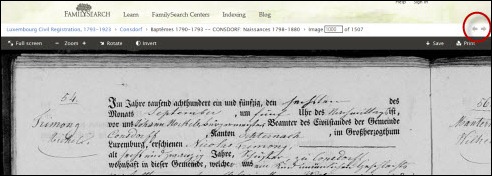
When I got to image #1008, I learned that I was in the year 1851, so I still had a little ways to go to get to 1866.  I jumped to image #1200 and repeated the process, getting to image #1202 and the year 1862.  A few more numbers and arrow clicks, and on image #1267 there was the index for 1866.  And there in alphabetical order on that page was a listing for Margaretha Kremer, born 31 October 1866.  The index indicated her record was #38.

Now I had to go backward in the images to find her record (remember, the index is at the END of the year).  I used the arrow buttons to move back and found her record on image #1265.
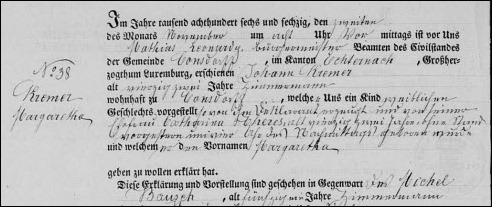
Now, had I not found her in 1866, I would have begun the process of looking a few years before and after, following the same process to jump around in the images.  Alternatively, you could use the arrow buttons to move through the records image by image.  But because each image has to load, you’re better off trying to get into the neck of the woods you need to save a little time.

After I found her record, I then began to search for her husband in the Echternach records.  Using the same process, I found him rather quickly (his birth year was at the beginning of the set).  After I found his, I then decided to search for his brother and any other Schwartz surnames, looking at each year before and after his.  Since I was acclimated to a particular spot in the images and knew about how many births occurred on average, I entered images numbers to get me close to the index and used the arrow buttons to navigate to the index. 

It took about six to seven hours total to go through several sets of records, looking for all entries for the surname Schwartz, including all of the birth records for the years available and marriages for the years 1845-1857.  In the end, I found my second great-grandfather, Johann Schwartz, and his brother Heinrich, both of whom I’ve been working on in American records.  I also found several siblings for them, and suspected the others were cousins.  After finding their father’s birth record, my third great-grandfather, Ferdinand Schwartz, I learned who his parents were (putting me back another generation on this line) and found at least two brothers, providing the link to the other Schwartzes I had uncovered as suspected cousins…they are absolutely cousins.

I still have several marriage records to go through, and then on to the deaths.  Then there is of course Margaretha Kremer’s clan in Consdorf that I need to research.  I am excited to keep going on this journey and am very thankful that these records are available online through FamilySearch for me to peruse at my convenience.

Once I get through these records, I will come back to my American research and hopefully start answering some of the outstanding questions I have about these families.  And when I answer some of those questions and continue to learn more, I’m sure I’ll be back to uncover more information in the Luxembourg civil registrations…at my convenience, of course!

Share/Bookmark

Friday, October 7, 2011

Friday Finds – 10/07/11

Weekly column sharing genealogy-related things that I’ve found.

New-to-Me Blogs

Online Posts/Articles

Print Articles

  • “Write On!”  Writing Your Family History,” by Lisa Alzo, Internet Genealogy, Jun/Jul 2011.
  • “Leafing Through History:  What Our Ancestors Read,” by Diane Dittgen, Internet Genealogy, Aug/Sept 2011.
  • “The Substance of German Dialects,” by Peter Pabisch, German Life, Aug/Sept 2011.

Websites


Share/Bookmark

Tuesday, October 4, 2011

Can Anyone Translate?

So Margaret Kramer (aka Margaretha Kremer) really was born on 31 October 1866 in Consdorf, Echternach, Luxembourg.  Seventy-eight years after her birth, her son reported the correct birth date for her death certificate.  The other information he provided was also correct, as far as what Margaret herself provided for her marriage license in 1888.  Her birth date, place, and father have now been confirmed by a birth record I just located on FamilySearch (Luxembourg Civil Registration, 1793-1923 > Consdorf > Baptêmes 1790-1793 -- CONSDORF: Naissances 1798-1880).

Below are two images.  The first one is the a page from the index for the year 1866, which lists Margaretha Kremer with a birth date of 31 October.  The second image is the actual record, which indicates her father’s name of Johann.  The problem is, I have no idea what the rest of this record says…can anyone translate the record?

The original image can be viewed and enlarged here.

Would love some help on this.  I must admit, it’s my first successful “across the pond” search (hey, one out of five ain’t bad)!  Now if I only could figure out if Peter Kremer, who witnessed Margaret’s marriage, is somehow related…


Share/Bookmark

  © Copyright 2008~2013. All rights reserved.

  © Blogger template 'Minimalist E' by Ourblogtemplates.com 2008

  Social media icons are from GraphicsFuel.com

Back to TOP  

Related Posts Plugin for WordPress, Blogger...