Picture

Sunday, August 29, 2010
Weekly Finds - My Diigo Bookmarks (weekly)
Posted from Diigo. The rest of my favorite links are here.


Sunday, August 22, 2010
Weekly Finds - My Diigo Bookmarks (weekly)
-
War of 1812 Genealogy Resources
via Newberry Library
-
via FamilySearch Wiki
-
Blog Archive » Essential Research Tools – Research Logs and Research Reports
via GenealogyandFamilyHistory.com blog
-
A census of pensioners for revolutionary or military services - Annotated
via Internet Archive
-
via Internet Archive
-
Home life in colonial days by Earle, Alice Morse
via Internet Archive
-
Researching Your Old Chicago House
via Illinois State Genealogical Society Blog
-
Sources for Free Online Family and Local Histories
via Genealogy Insider
Posted from Diigo. The rest of my favorite links are here.
Sunday, August 15, 2010
Create a Table of Contents for Your Blog (Blogger)
If you’ve had a blog for awhile, you probably have numerous posts. Many of us who use Blogger, use the Label feature to categorize our posts. We then use the Label widget to display those categories making it easier for people to find all the posts in that category. Unfortunately, this list can get extremely long. Additionally, when you click on the category link, it takes you to a page that produces the full-length posts in that category. I have been looking for a way to use the new Pages feature on Blogger to display my Label list as opposed to the widget sidebar. Yesterday, I finally found a way to dynamically (automatically) create this page.
Over at Abu Farhan’s blog, I found the following post: Table of Contents and Accordion for Blogger. Abu provides a quick and easy way to create a table to contents page by topic, simply by putting a few lines of HTML on a Blogger Page. The nice thing about this particular method is that it will only display a list of titles for a particular label when expanded (see example below).
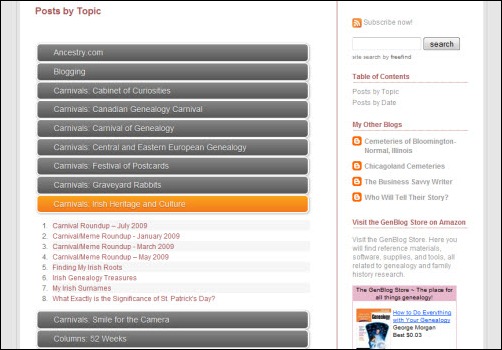
Abu also provides a method to create a page for your Blog Archive, so you don’t have to display it in your sidebar. Again, it’s as simple as copying a few lines of HTML (see Table of Contents Categorized by Dates) The page lists the post titles by date for each month (see example below).

I like both of these methods, so I have created a page for posts by topic and posts by date. The links are accessible from the blog sidebar under the heading Table of Contents.
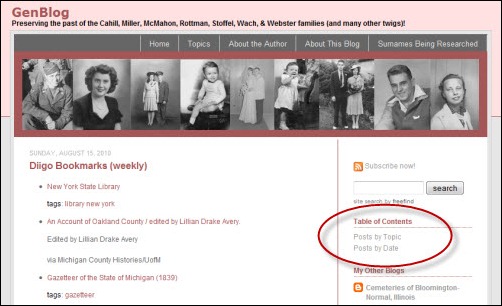
You may also notice that my blog design changed a little bit. In addition to removing the Label and Blog Archive widgets, I changed the banner at the top and removed some other items from the sidebar. Hope you like the new format!
Diigo Bookmarks (weekly)
-
An Account of Oakland County / edited by Lillian Drake Avery.
Edited by Lillian Drake Avery
via Michigan County Histories/UofM
Posted from Diigo. The rest of my favorite links are here.
Monday, August 9, 2010
Genealogy Writing Contest for Illinois Youth
Hot off the press this afternoon is the following press release from Illinois State Genealogical Society announcing a genealogy writing contest open to Illinois students ages 12-15. Be sure to pass this along to anyone you know who is eligible to participate. Keep in mind that the deadline is September 20, 2010.
August 9, 2010 – Springfield, IL. As the interest in genealogy and family history continues to increase across the United States, all Illinois students ages 12-15 are encouraged to participate in an upcoming essay contest sponsored by the Illinois State Genealogical Society (ISGS).
As part of its Fall 2010 Conference to be held on Saturday, October 23, 2010 in Peoria, IL, ISGS is providing an opportunity for Illinois youth to tell the stories of their ancestors.
The essay format:
- narrative; 2-page maximum; no cover page or back matter
- send the entry form (in the attached link) with the essay; do not put entrant's name on the essay
- word-processed final draft on standard, white print paper
- 12 pt. Times New Roman font, double-spaced
- entries must be postmarked no later than September 20, 2010
- no e-mail entries accepted
- choose one of the following topics:
- The Story of My Family Connection to (Historical Event)
- Why My Family Settled in (Geographic Area)
- The Immigration Story of My (Ancestor)
Prizes:
- First prize, $50
- Honorable mentions (two), $25 each
The deadline for entries is September 20, 2010. Access the entry form here (opens in PDF): http://www.rootsweb.ancestry.com/~ilsgs/projects/forms/EssayEntryForm.pdf.
About Illinois State Genealogical Society
The Illinois State Genealogical Society (ISGS) was organized in October of the Illinois Sesquicentennial Year, 1968, and is a non-profit, educational organization. ISGS was established for the following purposes:
- To stimulate an interest in the people who contributed to the establishment and development of the State of Illinois.
- To seek, preserve, and make available data pertaining to individuals, families, and groups who lived in Illinois and to events which took place therein.
- To inform people of the value of, and need for, preserving family and local history for posterity.
- To encourage the formation of local genealogical societies and to coordinate and disseminate information.
The ISGS genealogical collection is located in the Abraham Lincoln Presidential Library in Springfield and an administrative office is maintained in the Illinois State Archives. For more information visit http://www.rootsweb.ancestry.com/~ilsgs/.
Sunday, August 8, 2010
Diigo Bookmarks (weekly)
-
New York State Comptroller's Office Revolutionary War Accounts and Claims - Annotated
-
History of the late war between the United States and Great Britain
-
Geographical gazetteer of Jefferson county, N.Y., 1685-1890
via Internet Archive
-
A Wiki for Jefferson Co., NY
-
Gazetteer of the State of New York
via Google Books
-
Adams, NY History and Genealogy - Annotated
Historic Writings Regarding South Jefferson County, NY
-
via USGenNet
-
Sackets Harbor, NY
-
The Battle of Big Sandy & Carrying of the Great Rope, 1814 - Annotated
Involves Sackets Harbor. Several sources cited that may be helpful.
-
Naturalization Declarations of Intention
via Cook County Clerk of the Circuit Court:
-
via The Descendants of the Signers of the Declaration of Independence
-
Recommended 18th Century Resources
via Descendants of the Signers of the Declaration of Independence
Posted from Diigo. The rest of my favorite links are here.
Friday, August 6, 2010
Friday Finds – 08/06/10
Weekly column sharing genealogy-related things that I’ve learned or found.
The majority of my week was spent looking into the history of a few New York counties, as well as references for the War of 1812 and the Revolutionary War. So this week’s finds are books available online and website on these subjects. But before I get into that, I did find an interesting article (posted on Facebook by Becky Jamison): “Lives of the dead come to life on tombstones.”
Revolutionary War
New York in the Revolution as Colony and State: Volume 1 (via Internet Archive)
New York in the Revolution as Colony and State: Volume 2 (via Internet Archive)
War of 1812
History of the Late War Between the United States and Great Britain Comprising a Minute Account of the Various Military and Naval Operations (via Google Books)
Sackets Harbor Battlefield Alliance (website)
Index of Awards on Claims of the Soldiers of the War of 1812 [New York] (via Ancestry)
Jefferson County, NY
Geographical Gazetteer of Jefferson County, N.Y., 1685-1890 (via Internet Archive)
A History of the Jefferson County Region (website)
Jefferson County Historical Society (website)
Jefferson County Wiki (website/wiki)
Adams, NY History and Genealogy (website)
Jefferson County (website via USGenNet)
Sackets Harbor History (website via 1000 Islands)
A History of Jefferson County in the State of New York From the Earliest Period to the Present (via Google Books)
Our County and Its People: A Descriptive Work on Jefferson County, New York (via Internet Archive)
The Growth of a Century as Illustrated in the History of Jefferson County, New York from 1793-1894 (via Internet Archive)
Oneida County, NY
Oneida County Historical Society (website)
History of Oneida County, New York From 1700 to the Present Time: Volume 1 (via Internet Archive)
History of Oneida County, New York From 1700 to the Present Time: Volume 2 (via Internet Archive)
History of Oneida County, New York With Illustrations and Biographical Sketches of Some of Its Prominent Men and Pioneers (via Ancestry)
Our County and Its People: A Descriptive Work on Oneida County, New York (via Internet Archive)
Cayuga County, NY
History of Cayuga County, New York With Illustrations and Biographical Sketches of Some of Its Prominent Men and Pioneers (via Internet Archive)
Cayuga County Historian’s Office (website)
History of Cayuga County, New York (website)
History of Auburn (via Internet Archive)
Historical Records of a Hundred and Twenty Years Auburn, N.Y. (via Internet Archive)
New York
Gazetteer of the State of New York (via Google Books)
Names of Persons for Whom Marriage Licenses Were Issued by the Secretary of the Province of New York, Previous to 1784 (via Google Books)
Thursday, August 5, 2010
More On Timelines
One of the challenges in the GeneaBlogger Games earlier this year had to do with timelines. You can read my post, Working With Timelines to see what I did back in February using Legacy. In this post, I will share with you a different method for creating a timeline.
While Legacy offers a variety of options for their timeline reports, it didn’t give me an option (or at least I couldn't find it) to plot more than one individual, from different families, in one timeline. Nor could I find a way to do this in Genelines for Legacy. The project I am working on involves four different family groups in two different generations. Some of their starting places were the same, some of their ending places were the same, and some overlapped in the middle. For months I’ve been trying to figure out how to make my own timeline showing four different individuals. I could visualize it in my head, but I was at a loss.
A few weeks ago, it hit me: use Visio. Visio is a Microsoft program used primarily for charts, diagrams, and such (e.g., organizational charts, flow charts, mind maps, web hierarchy, timelines, and much more). I used Visio quite a bit at my last job, and even used it to create timelines for project schedules. Unfortunately, it is not a cheap program (over $200 for Standard 2010, yikes!), but I did find a program called Edraw Flowchart for $50, which may as well be Visio by another name (there is also Edraw Max for $100, which seems to combine all of their suites: Flowchart, Org Chart, and Network Diagram). Although I used Visio for my timeline, I did download the trial version of Edraw and was able to do the exact same thing, including a huge page size. My version of Visio is from 2002, so who knows, maybe I’ll pop for Edraw Max someday.
Okay, so moving on to the timeline. Basically, this particular timeline is looking at four different people over the span of about 100 years.

In order to accomplish this, the page is about 75 inches wide. I don’t plan to print it out, but I could print it on a plotter if need be. The image above is a portion of the timeline. I used four different colors to represent each person’s events (the boxes). I then began adding brackets for periods of time where I have no events, noting possible locations to look for records. I also added notations related to boundary and/or location name changes as callouts, which significantly helps in record searches. In addition, I’ve added other notes and questions as a callouts.

This timeline has been a tremendous help while analyzing these four individuals together. For example, my sixth great-grandfather, Solomon Norton, is known to be living in Rutland County, Vermont from 1778 to at least 1820. His daughter, Sarah Norton, married Aaron Webster allegedly in 1797, with locations noted as Washington County, New York or Rutland County, Vermont. The timeline suggests either of these two as possible locations, as well as two other New York counties were Aaron appear around that time period.
In another instance, this timeline unveiled a possible error with regard to a place of birth for Aaron and Sarah’s first-born son, Luther. The Webster genealogy [1] indicates his place of birth as Sackets Harbor, NY in August 1799. Looking at the timeline, the family is found in Fabius, Onondaga County, New York in the 1800 census. While it is certainly possible that Luther was born in a different place than their enumeration a year later, I also noted that Sackets Harbor wasn’t really a place until it’s settlement in 1801. Furthermore, four subsequent children were also reportedly born in Sackets Harbor, which is possible, but the timeline also reveals that Aaron bought land in Adams, New York in 1804, which is were the family was found in the 1810 census. Without further analysis, it looks like they went from Oneida County in 1799 to Onondaga County in 1800, back to Oneida County in 1802, which seems a little strange, although not impossible. The occurrence of Sackets Harbor and Adams within the same time period is not a major concern as they are very close to one another, so either location could be correct for the events occurring between 1802 and 1812 (through perhaps 1818).
Essentially, the timeline is illustrating information and patterns that all need to be taken into consideration during analysis and further research. By plotting some of the individuals together, I can also how they relate to one another in terms of location. For example, by 1818, Aaron and his family were located in Aurelius, Cayuga County, New York; he was also enumerated here in 1820. My fifth great-grandfather Robert Parks was also enumerated here in 1820. Aaron and Robert both ended up in Oakland County, Michigan shortly thereafter, seemingly “together” (Aaron bought federal land in in November 1821; Robert bought land by deed in October 1822). Seeing these locations in the timeline suggests that they knew one another before they relocated to Michigan. This is something I suspected given the supposed birth locations for some of their children, however I barely made note of it until I plotted it on the timeline, then it became an obvious assumption.
All in all, I would encourage you to visually diagram your timelines, whether for one individual or a few that seem to go together. I suspect that the timelines offered in other genealogy programs are similar to that of Legacy, and although somewhat helpful, the written blurbs in chronological order from top to bottom over a series of pages, for one individual, doesn’t really help the visualization of data and patterns. I know I missed several things until I created a visual diagram and plan to use this method going forward.
Notes
1. William Holcomb Webster and Rev. Melville Reuben Webster D. D., History and Genealogy of the Gov. John Webster Family of Connecticut With Numerous Portraits and Illustrations (Rochester, New York: E. R. Andrews Printing Co., 1915), 401.
Wednesday, August 4, 2010
Collateral Family Deeds in Oakland County: Part 1
This is a list of the deeds I have transcribed for my known collateral families in Oakland County, Michigan. Part 1 includes all deeds found in Volumes 1 through 10 of the Oakland County Deeds.
All of the deeds were transcribed by me. The links will take you to the transcription, which is available on Scribd.
| Date | Grantor | Grantee |
| 1825-05-24 | Silas Glazier | Elisha Glazier |
| 1828-08-13 | Austin E Wing | Elisha Glazier |
| 1828-10-13 | Daniel Vanantwerp | Elisha Glazier |
| 1829-11-28 | George Postal | Nelson Madden |
| 1830-10-02 | Elisha Glazier | James Kemp |
| 1832-09-12 | George M Shaw | William Nichols, Jesse Decker, Philip Bigler and Elisha Glazier |
| 1833-11-15 | Elisha Glazier | Tenison F Glazier |
| 1834-06-13 | Elisha Glazier | Benjamin F Pierson |
Webster Family Deeds in Oakland County: Part 1
This is a list of the deeds I have transcribed for my known Webster family in Oakland County, Michigan, as well as other Websters I found along the way, who may or may not be related. Part 1 includes all deeds found in Volumes 1 through 10 of the Oakland County Deeds.
All of the deeds were transcribed by me. The links will take you to the transcription, which is available on Scribd. I have also updated my Google map for the known Webster family (it includes my Parks family as well).
Known Webster Family in Oakland County
| Date | Grantor | Grantee |
| 1823-05-14 | Aaron Webster | James Thorington |
| 1823-08-11 | Aaron Webster | Elizur Goodrich |
| 1823-10-11 | Luther N Webster | James Thorington |
| 1824-03-01 | Luther N Webster & Robert Parks (adms for Aaron Webster Estate) | Leander Wood |
| 1824-03-20 | Luther N Webster & Robert Parks (adms for Aaron Webster Estate) | Nathaniel Millard |
| 1824-04-19 | Luther N Webster | Sheldon M Perry |
| 1824-05-25 | Luther N Webster (adm for Aaron Webster Estate) | Ebenezer Smith |
| 1825-01-28 | David Lyon | Luther N Webster |
| 1826-09-06 | Luther N Webster | Mason J James |
| 1827-05-17 | Chester Webster | Hervey Topping |
| 1827-06-29 | Luther N Webster | Michael Pearsall |
| 1828-02-04 | Moses Olmstead | Luther N Webster |
| 1829-01-01 | Nathaniel Hathaway | Chester Webster |
| 1830-07-02 | Northrup Jones | Luther N Webster |
| 1833-04-16 | George M Shaw | [William] Aaron Webster |
| 1833-04-16 | [William] Aaron Webster | George M Shaw |
| 1833-05-08 | Calvin P Webster | Isaac Smith |
| 1833-05-11 | [William] Aaron Webster | John B Young |
Not-So-Sure-About Websters in Oakland County
| Date | Grantor | Grantee |
| 1831-10-18 | William Webster | James T Rhoads |
| 1835-03-11 | John T Webster | Charles C Hascall |
Parks Family Deeds in Oakland County: Part 1
Oh no, not another post on land records! Don’t worry, if you’re not interested in this family, you can move on…you won’t miss any tips or great stories. This is simply a list of the deeds I have transcribed for my known Parks family in Oakland County, Michigan, as well as other Parks I found along the way, who may or may not be related. Part 1 includes all deeds found in Volumes 1 through 10 of the Oakland County Deeds.
All of the deeds were transcribed by me. The links will take you to the transcription, which is available on Scribd. I have also updated my Google map for the known Parks family (it includes my Websters as well).
Known Parks Family in Oakland County
| Date | Grantor | Grantee |
| 1822-10-12 | Charles C Trowbridge | Robert Parks |
| 1824-01-23 | Salmon Mathews | Robert Parks |
| 1826-04-07 | Robert Parks | Calvin C Parks |
| 1827-03-02 | Robert Parks | James Skidmore |
| 1827-06-29 | Robert Parks | Michael Pearsall |
| 1829-03-03 | Benjamin Hoyt | Michael Pearsall, Robert Parks and George P Morse |
| 1829-03-23 | Robert Parks | Clark Beardsley |
| 1829-06-23 | Ebenezer Smith | Allen Minor Parks |
| 1830-02-27 | Allen Minor Parks | Calvin C Parks |
| 1830-11-23 | Calvin C Parks | Van Rensalaer Harper |
| 1831-03-17 | Robert Parks | Betsey (Parks) Webster |
| 1831-06-02 | Robert Parks | Samuel W Harding |
| 1831-06-21 | Joseph Clark Hemmingway | Robert S Parks |
| 1831-06-23 | Robert S Parks | Salmon J Matthews |
| 1831-06-25 | Lucy Goodrich | Robert S Parks |
| 1832-01-19 | Calvin C Parks | Salmon J Matthews |
| 1832-03-13 | Calvin C Parks | John Allen |
| 1832-03-13 | John Allen | Calvin C Parks |
| 1832-04-03* | John K Smith | Calvin C Parks |
| 1832-04-03 | John K Smith | Calvin C Parks |
| 1832-09-06 | Calvin C Parks | John E Beardsley |
| 1832-11-12 | Charles C Hascall | Calvin C Parks |
| 1833-01-13 | Peter Schoonover | Bennett Beardsley & Calvin C Parks |
| 1833-05-16 | Allen Minor Parks | Jonathan F Noble |
| 1833-05-17 | Calvin C Parks | Henry H Panton |
| 1833-09-04 | Bennet Beardsley | Calvin C Parks |
| 1833-10-01 | Oakland County | Calvin C Parks |
| 1833-11-16 | Jonathan F Noble | Allen Minor Parks |
| 1834-11-14 | Calvin C Parks | Salmon T Matthews |
| 1835-05-02 | Calvin C Parks | Henry H Panton |
| 1835-09-10 | George Clark | Calvin C Parks |
| 1835-10-26 | Calvin C Parks | Arthur Power |
| 1835-10-31 | Ebenezer Pennell | Calvin C Parks |
| 1835-12-18 | Bennett Beardsley | Calvin C Parks |
| 1835-12-18 | Bennett Beardsley | Calvin C Parks |
*Recorded in Oakland County, but land is located in Lapeer County.
Not-So-Sure-About Parks in Oakland County
| Date | Grantor | Grantee |
| 1831-09-03 | Benjamin Bresee | William Parks |
| 1833-02-09 | William Parks | Nathan Taylor |
| 1833-03-04 | Henry Vanamburgh | Lorilla Parks |
| 1833-03-04 | Henry Vanamburgh | Smith Parks Jr |
| 1833-05-21 | William Parks | Hira Law |
| 1833-05-22 | Daniel Lake | William Parks |
| 1833-05-24 | Harvey Cone | William Parks |
| 1833-10-24 | Vincent Parks | Smith Parks |
| 1833-12-03 | Alanson Parks | Joab Guile |
| 1834-01-27 | William Delling | James Parks |
| 1834-06-18 | Alanson Parks | Smith Parks |
| 1834-10-02 | Smith Parks | Smith Parks Jr |
| 1835-03-03 | William Parks | Smith Parks |
| 1835-05-25 | Samuel B Pickett | Esther Parks |
| 1835-09-?? | Joseph Bishop | John Parks |
Tuesday, August 3, 2010
Keeping Track of Land Transactions
As you probably know, I have been busy collecting and transcribing deeds for my Oakland County, Michigan families. While I’ve recorded each transaction in my database, it’s hard to visualize what occurred with each parcel, when and between what parties. Over the last few days I’ve been brainstorming about how I could make it easier to track all the transactions for a particular parcel. Today, I’ve been working on compiling the transactions in a Word document and thought I’d share with you why and how I did it, as well as the things I found as a result.
While I don’t like having the same data in many places or across several types of media and/or formats, I thought it was important to pull out the land transactions to better analyze them together. So I created a Word document for each of the two main families I am working on. Within that document are tables for each parcel of land.

I used the following columns:
- Date (the date the transaction took place)
- Party 1 (I prefer to have the relative in this column for easy reference)
- Trans. Type (sold to, purchased from, mortgaged to, financed mortgage to, quit claimed, etc.)
- Party 2 (the other person or persons involved in the transaction)
- Price (Trans. Amount might be a better label)
- Acres
- Divided? If so, what part? (this is to indicate whether only a particular part of the parcel was transacted and what part)
- Still In Family? (this is to keep track of whether or not any of the land remained in the family as well as when it left the family’s possession)
The parcel tables are arranged by Township, then Range, then Section so I can easily find a particular parcel. Each transaction is listed in date order, from oldest to newest. Most of the transactions followed the typical pattern you would expect; it came into possession and later left their possession. But by putting these land transactions together in this manner, I was able to see a variety of issues.
For example, there are a few parcels where the only transaction is the sale. Keep in mind I have started with the first volume of deeds, as well as the federal land grants, so I should have the purchase transaction (or so you would think). Also note, that as far as I can tell, the land did not enter their possession through inheritance. In these cases, I created a footnote pointing out that I have no idea how the person came into possession of the land they subsequently sold. After I entered all the transactions for all of the family land, I took a closer look. In two cases where the initial possession is unknown, I do actually have an index entry indicating a purchase of some kind with an approximate date. Unfortunately, for whatever reason, I was unable to located these two deeds. I went back to the Word document and amended the footnote to include the possible purchase transaction.
Another reason this was helpful was to see how the a larger parcel of land became divided. Since I record the parcel as that of the original purchase transaction, I subsequently add the sale transactions that took place dividing the land. See example below.

In this case, Robert originally purchased 80 acres in 1823. But in 1827 he sold off 40 acres, which I can easily see in this table. I also noted in the “Still in Family?” column that some of the land is still in the family (after this particular transaction took place). (Note: I do not have any further transactions for this piece of land; I’m only up through volume 10 with a “whole heck of a lot” of volumes still to go.)
This process also led me to question some things. For example, Robert S Parks purchased 80 acres of land, described as T3N R10E, Section 26, E 1/2 of SW 1/4. In another transaction, two days later, he sold 80 acres of land described as T3N R10E, Section 26, E 1/2 of SE 1/4. After carefully reviewing the deeds again (and then again), I am pretty certain that it was not a transcription or interpretation error. While it is possible that he bought one parcel of land and sold another, I have no purchase for the second one, so I am left to wonder if it was the same piece of land and that someone recording it made an error. More research needs to be done to determine if this is a correct theory and if so, which quarter-section is the correct one.
Another set of questionable transactions relates to land my fifth-great-grandfather, Aaron Webster, purchased from the government in 1821, namely T2N R11E, Section 5, SE 1/4. Just before his death in 1823, he was selling off his land in Troy Township because he decided to build a saw and grist mill in neighboring Pontiac Township. In May of 1823, before his death, he apparently sold this parcel of land to James Thorington for $2,000. But, in March 1824, after his death, this SAME piece of land is sold (by the administrators of his estate) AGAIN this time to Nathaniel Millard. No idea what’s going on with this one!
It took me roughly half the day to record about 50 or so transactions in Word and update my Google map, but I think it was well worth the time as illustrated above. Additionally, by having these transactions laid out in this particular format, I can see if there are transactions missing, follow up on mortgaged property, and trace any particular piece of land from the time it was sold by the government until any point-in-time.
If you have your own system for tracking land transactions, please share it by leaving a comment. I’d love to see how others do it.
Monday, August 2, 2010
Resolution Review
Become more familiar with genealogy research methods and resources overall.
While this in and of itself is an ongoing learning process, I have made positive strides forward. To date, I have completed eight courses toward my certificate in American Records through the National Institute for Genealogical Studies (another course is in progress). Some of the courses were a review of things I already knew, but I still walked away with new tidbits. Regardless of the “newness” of the record type or method studied, I walked away with a stronger confidence in using particular records and practices. I continue to apply what I’ve learned to my personal research, which is now stronger as a result.
I also review several journals to learn from others, from methodology to far-flung resources, and everything in between. I take what I learn from these papers and case studies and apply it to my own research whenever possible.
Learn about various land records and maps.
I dabbled a little bit into this just prior to writing these 2010 resolutions, which included reviewing books/articles and attending a lecture on the subject. I even tried my hand at federal land records.
Since then, I have scoured the deed indexes for a county of interest, and have begun to retrieve the deeds, as well as transcribe what I have found. So far, I have obtained records from ten volumes of deeds, which yielded just over eighty deeds covering roughly five families. There are still nearly 300 more deeds to obtain for this county and family groups.
In conjunction with the deeds, I have been reviewing county histories on the county of this research in order to understand any boundary or name changes that took place and when. I hope to find maps and/or plats relevant to the varied time periods during which my family resided in the county.
Learn the standards for writing family histories and genealogies.
I’m working toward this goal in a couple different ways. First, I joined the International Society of Family History Writers and Editors earlier this year. I also continue to review past and current issues of NGS Quarterly and The New England Historical and Genealogical Register as a point of reference as to good research practices, documentation, and genealogical writing. I’m now at the point where I need to practice. Back in March, I wrote a mini-genealogy about my great-great-grandfather James Manly GARRISON, using the writing style found in the NGS Quarterly and The New England Historical and Genealogical Register. I plan to work on more of these as time permits. Additionally, I have started working on some papers that I hope to submit to the NGS Quarterly someday.
I’m glad I took some time today to review my goals. It’s given me a bit of a confidence boost, knowing that I am setting goals and finding ways to achieve them, and actually following through on what I’ve set out to do.
How are you coming along with your genealogy goals/resolutions so far this year?
Sunday, August 1, 2010
Diigo Bookmarks (weekly)
-
ProQuest - Genealogy and Local History
List of resources by state.
Posted from Diigo. The rest of my favorite links are here.
Subscribe to:
Posts (Atom)
Julie Cahill Tarr, Genealogist
Julie is a genealogist who specializes in writing, editing, and graphic design. If you are looking for someone to help organize your family data into a book or prepare a research article for publication, Julie can help. Other services include the development of educational materials such as books/booklets, articles, and online courses. See "About Julie" for additional information.


Legacy QuickGuide™
Using Historical Newspapers for Genealogy Research

Lineage Societies and Genealogy

Researching County Histories

US City Directories

My Other Blogs

FGS 2013 Conference Ambassador

Join me at the FGS 2013 Conference in Fort Wayne, Indiana, August 21-24.


