Picture

Picture
Showing posts with label Fold3. Show all posts

Friday, March 30, 2012

Fearless Females – Memorial Pages

Back in 2010, in honor of Women’s History Month, Lisa Alzo created a list of writing prompts for each day during the month of March.  I didn’t participate in 2010, so I’m going to take the opportunity to participate this year, since Lisa was kind enough to resurrect her prompts for 2012.

Create a free Fold3 Memorial Page or a Genealogy Trading Card at Big Huge Labs for a female ancestor. Some of you may have created your own card back in September 2009 following Sheri Fenley’s post over at The Educated Genealogist. This time, the card is for your female ancestor. Tell us about who you've selected and why and then post a link to what you've created.

I had previously created or contributed to five memorial pages at Fold3, one for my dad and one for each of my grandparents.  For my grandparents, I started with the SSDI entry and added a few facts and a photo or two.  It’s been almost two years since I did that.  Because of this prompt, I went ahead and updated all five pages, added sources, and some more images.

Since this prompt deals with female ancestors, here are the links to the pages for my grandmothers.  I hope that some of my family members will take the time to add their memories and stories to these pages.


Read all of my Fearless Females posts.


Share/Bookmark

Saturday, August 13, 2011

Can You Spare a Dime?

Back in April I wrote Are You Up for the Challenge? discussing the project that FGS is working on to digitize the War of 1812 pension files. 

In that post I reported that Indiana Genealogical Society stated a matching program where they will match contributions they collect up to $10,000.  I am happy to report that as of today, they have raised $9,700, just $300 shy of their goal!

IGS hopes to meet their $10,000 goal by August 31st, so if you have even just a few dollars to contribute to this worthy project, please head over to their website and make a contribution.  Not only will they match your contribution, Ancestry has also agreed to match all the donations, essentially quadrupling your contribution.

Remember, this digitization project aims to have the pension files available for free on Footnote.  And although they plan to have the digitization complete in 2015, they are busy working to get the files scanned and uploaded as they go…as of today there are 58,021 images available.

UPDATE 9/1/11 – It’s official…IGS raised $12,117 for the project, all of which will be matched by both IGS and Ancestry.  You can read more here.


Share/Bookmark

Saturday, June 5, 2010

Saturday in the Attic – 06/05/10

I found this business card among my family papers.  My mom thought her mom had acquired it somewhere along the line, but…. 

Oddly enough, a few weeks before I found this, I had been working on my Parks family, so R H PARKS, to me read, Robert Hall PARKS.  I thought it was a long shot.  Robert Hall PARKS was born in Michigan and lived in Illinois and at some point, Iowa.  What I didn’t know at the time was that he did actually live in New York.  I remembered that his daughter Isabel was supposedly married in New York.  I did confirm that through her marriage record.  But having this business card made me wonder if this was actually my Robert Hall PARKS,as he was tied to New York if only through his daughter’s marriage.

I started to dig around and found the marriage announcement of Isbael to Samuel Brewster in the New York Herald.  I then started to go through the New York City directories on Footnote and consistently found listing for Robert H Parks from 1880 to 1894.  What tipped me off that this was possibly my Robert, was the entry in the 1880 directory:

Parks1880

Although it lists him as a broker working at 5 New, his residence is indicated as Ill.  I found him, his wife, and his daughter in the 1880 census living in a hotel in NYC.  At this point, I had at least placed the him in New York, and it was apparent he had just moved around the time of the census.  As I made my way through each directory, I found the following listing in 1893; it’s the only one that has this business address (there were several other business addresses throughout the years).

Parks1893 

Who knew this hunch would lead to anything.  All I had was this card (with initials only, albeit) and a dead-end for him in Lake County, Illinois in the 1870 census.  The information about his daughter’s marriage was initially vague and unsourced.  But once I confirmed that, I thought, maybe they all moved to New York and that’s why I can’t find any of them in Illinois.  All of this was confirmed when I found his obituary, which stated at the end “Chicago papers please copy.”  That right there tied him back to Illinois.  And because of this one little card, I was able to figure out when and where Robert and his wife died (both in 1894 in New York) and learn more about his daughter’s family.

Now whether my maternal grandmother actually found this or not is still a mystery, as Robert Hall PARKS is my first cousin five times removed on my dad’s side!


Share/Bookmark

Friday, April 30, 2010

Friday Finds – 04/30/10

Weekly column sharing genealogy-related things that I’ve learned or found.

Note:  Some of these are from last week, but I forgot to post them.

List of NARA Microfilm Publications and Original Records Digitized by Our Digitization Partners – This is list of records that have been digitized and are available via Ancestry or Footnote, as of March 2010.  They will update the list as more records become digitized.

Preparing for a Genealogy Research Trip – Elyse wrote a great article about getting ready for your next research trip.  She even includes a list of items to bring with you

52 Weeks of Online American Digital Archives and Databases: Iowa – Miriam delivers again in this series, this time focusing on Iowa.  I can’t wait to dig further into these sources for my Linn and Muscatine County families.

Non-Population U.S. Census Schedules Online – Kimberly Powell writes about the non-population schedules (agricultural, industry/manufacturing, and social statistics) that are being added to Ancestry.  She notes, “Not all available schedules are online as of yet. The states covered include California, Illinois, Iowa, Kansas, Maine, Massachusetts, Michigan, Nebraska, New York, North Carolina, South Carolina, Texas, Virginia, and Washington Territory. Some states may have one type of non-population schedule online, but not others.”  Since Michigan was on the list, I spent the better part of the day collecting the agricultural schedules for my folks in Oakland County!

Connecticut Archives, 1629-1820 – According to the Connecticut State Library’s website, “The ‘Connecticut Archives’ are the papers and correspondence of the General Assembly, the Governor and Council, and other colony or state officials. Included in this collection are petitions, drafts of bills, acts, resolves, and other early government documents.”  Most of them are indexed, and the indexes are available online.  More on this is a separate blog post.

The Source:  A Guidebook to American Genealogy – The third edition, edited by Loretto Dennis Szucs and Sandra Hargreaves is available online through the Ancestry.com Wiki.  It’s nice to see this online, as I do not own this book.

Red Book: American State, County, and Town Sources – The third edition of this book, edited by Alice Eichholz, is also available online through the Ancestry.com Wiki.  Although I own this book, it’s nice to have an online version for the times I need it when I’m away from home.

The Federation of Genealogical Societies to Digitize War of 1812 Pension Files – I’ve know about this for awhile now, but keep forgetting to post about it.  Running across Dick Eastman’s post, I figured now was as good a time as any.  The post also includes some general information about the War of 1812 and pension files.  I made three seperate donations:  one in honor of Marsha Hoffman Rising, and the other two for my fifth great-grandfathers who served in the war, Robert Parks and Aaron Webster.

FamilySearch Record Search – Tons of new records available this week!

Historical Register and Dictionary of the United States Army (1789-1903) – This book, by Francis B. Heitman, is available via Google Books.  Various details, particularly about officers.

List of Officers of the Navy of the United States and of the Marine Corps from 1775 to 1900 – This book, edited by Edward W. Callahan, is available via Google Books.


Share/Bookmark

Friday, February 26, 2010

GeneaBlogger Games – Days 12-14

Here’s my status for the final days:

I finally opened the boxes of photo sleeves I purchased at the beginning of December (yes I’ve had them for over two months).  I purchased several varieties of sleeves that fit into a standard binder.  The brand I selected is Print File, which I purchased from Adorama.  They are supposedly archival quality, although it does not specify what exactly that means (the packaging states no PVC).  I filled up one three-inch binder, well over 20 photos, so task 3C is complete.

I submitted information to the Footnote page created (via SSDI) for my maternal grandparents.  I also created the Facebook “I Remember” page for each.  Awhile back, I created pages for my dad and his parents.  You can visit the Footnote pages for Harold Miller, Marie (Rottman) Miller, Joseph Cahill, John Cahill and Joan (McMahon) Cahill.

GenBlog%20Signature%5B4%5D[8]


Share/Bookmark

Friday, November 13, 2009

Using the City Directories at Footnote

I’ve been spending quite a bit of time over the last few weeks exploring the city directories available at Footnote.  The first few days I was frustrated as my searches weren’t turning up anything.  But then I realized why, and have been able to effectively search the directories.  This post will explain how the directories work on Footnote, and how to effectively find the people for whom you are searching.

First, it is important to understand how the directories are set up on Footnote, in order to make the most of your searches.  Unlike some of the other collections where all names are annotated (such as American Revolutionary War collections), the directories usually only have the first entry annotated.  So when you search for John Smith, you are not likely to find a listing in the search results. 

There are ways around this issue.  First, the directories are searchable using OCR, which stands for Optical Character Recognition.  Simply put, the search analyzes the text on a particular page looking for optical characters that match the search term.  Unfortunately, it’s not foolproof, especially since some characters are mistaken for others and if the page is faded or has other flaws, it may not recognize the characters at all.  Even with this search, your exact search may not be returned in the search results, which I will explain why using an example later in this post.. 

So let’s dive in.

Navigating to the Directories

Choose Original Documents from the top navigation menu.

     nav1

Scroll down to City Directories and click on the title link.

     nav2

Scroll down to the state of your choice and click the state’s link.

     nav3

Click on the link for the city you want to search.

     nav4

Click on the Browse button.

      nav5

You will now see a screen that similar to that below:

     nav6

Performing a Search

From the screen you navigated to (see above), click on the year you want to search.  Then in the search box, type in the surname of the person you are searching for, the click on the Go button.

     search1

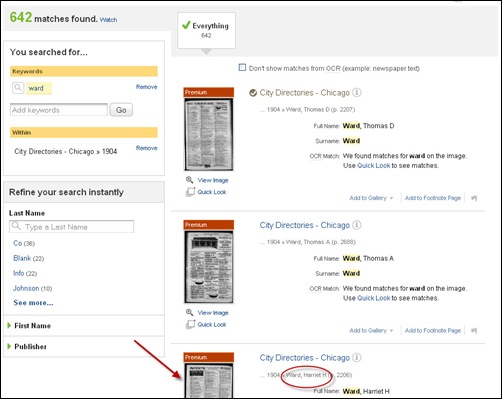
I searched for Ward in 1904.  There are 642 matches.  Because only the first listed name on a page is in the search results, I will not find anything for the person I am searching for, which is Bridget Ward.  So the strategy here is to find a page that is likely to have your person on it.  In this case, the third entry (for Harriett Ward) will put me the closest to Bridget, so I will navigate to that page.

     search2

Once you click on a page, it will take you to the viewer.  Here you can view the page, annotate it, save it, etc.  By using the filmstrip at the bottom, you can navigate to other pages.  In my case, I need to navigate backward to find Bridget.

     search3

In the filmstrip, the orange arrow indicates the current page.  An orange box around the page indicates that you have viewed that page.  When you hover over a page in the filmstrip, it will have a pop-up that indicates the name of the first person on the page; this will help you navigate to the page you need.  In my case, I just need to go back one page in order to find Bridget Ward.

Now this one was a pretty simple search, for two reasons.  First, the name I searched for happened to be the first name listed on a page, and was therefore annotated.  Second, the name was popular enough that it was bound to show up using the OCR search.  What do I mean by this.  Well, just looking at the screen above, you can see the name Ward clearly in three instances (and there are plenty more on the page).  Even if a few of them were flawed (e.g., was faded, page torn, crease through the name), the OCR could still pick up on other instances that are not flawed.  Let’s look at an example.

Returning to the search screen (click you back button twice), I am going to do a search for Stoffel in 1916.  The search results return only one match, which is not in the realm I am looking for.  It happens to be in the business section of the directory, not the individual section, so this does me no good.  We’ll look at why this was the only result in just a moment.

     search4 

So how do I navigate to a page within the realm of where I need to be?  I head back to the search screen and try a search with a more popular name near where my listing would be.  This time, I searched for Stocking.  The first item in the search results was for a page that leads with “Stirn, Nicholas.”  That’s close enough for me, so I click on that page to go to the viewer.  Using the filmstrip at the bottom, I navigate to the page that starts with “Stocknick, Anthony” to look for my Stoffel.  And there it is.

     search5

So back to the question:  Why didn’t this show up in the search results.  First, the page it terribly faded, making it difficult for the OCR to pick up the characters.  Second, there is only one instance of the name on the page, lessening the chance that OCR would pick up the instance (in the first example, there were plenty of instances of the name Ward, strengthening the chance that OCR would be able to pick up at least one of the instances).

Summary

Now that you know how the directory search in Footnote works, you have a better chance of finding what you are looking for using the strategies I provided in the example above.  The goal is to get close to the page you need, as opposed to getting to the exact page through the search (although it is possible in some cases).  Being creative in your search will help get you close enough.  Once you get close, simply use the filmstrip to navigate to the exact page you want.

And while your there, why not annotate the name you were searching for.  This will then show up in search results and help others.


Share/Bookmark

Wednesday, November 4, 2009

Finding Emil

I’ve written about my Emil MILLER brick wall before (Brick Wall - Emil MILLER/MULLER and German Brick Walls).  There are so many possibilities, as there are several variant spellings (Miller, Muller, Mueller, Moeller, Millar, etc.) and there happen to be many of them living in Chicago during the same time period.

Background

Emil MILLER was born about 1862-1864 in Germany.  He married Hulda WACH on 8 August 1886 in Chicago.  Together they had three children, all born in Chicago:  Heinrich “Henry” Frederick (b. 1887), Emil Charles (b. 1889), and Ida (b. 1891). 

Hulda is located in the 1900 census with daughter Ida, listed as a widow, living at 362 Rhine in Chicago.  This is apparently across the street from her sister, Alvina WACH Trapp, living at 365 Rhine with her husband and two children.  There is a 1900 census recording for an Emil, Emil, and Henry Miller, along with a Mary Cherwinsky (as mother-in-law).  The addition of this person, along with Hulda’s notation as a widow, have made me question whether this is my Emil, Emil, and Henry (see full explanation in the Brick Wall - Emil MILLER/MULLER post).

Moving Forward

Over the last week or so, I’ve been spending a lot of time on Footnote looking at the Chicago city directories.  There are many possibilities for my Emil, but nothing matches any of the information I had (which isn’t much).  So I decided it’s time to go to the map and try to figure out the most likely candidates based on relative location.

I had already plotted Hulda’s location on Rhine (which is no longer there, as the expressway now runs over that area).  Yesterday, I decided to take a closer look at their marriage license and see if they were married by a Justice of the Peace or a pastor.  Turns out, they were married by a pastor, so I went to the 1886 Chicago directory to see if I could find the church the pastor belonged to.  Fortunately, I found a listing for Trinity West Chicago Church (Evangelical Lutheran, German) where Rev. Richard Schiele was a pastor, located at 9, 11, 13 Snell.  By all indications, Snell is now Ada St., so I plotted it on the map.  The same church was were Emil and Hulda’s son Emil was christened in 1889, although by Rev. Robert Fahner.  Rev. Fahner also married Hulda’s sister, Alvina WACH and William Trapp in 1894.  Emil and Hulda’s sons were both married at the church:  Henry in 1909 (Trinity Luteran, 360 N. Ada, Rev. Robert Fahner) and Emil in 1915 (Trinity Lutheran, 742 N. Ada, Rev. Robert Fahner).

Again, none of the addresses for Emil’s matched the Rhine address, so I began to plot all the Emils I found that were is some close proximity to the church.  Many of them were within a few miles, but for ones that were either too far north or south, I did not plot them, assuming they are not relevant (I can always do this late, but I’m trying to narrow the field).  I started with 1886, since that was the year Emil and Hulda were married, and moved forward in time (through 1899), plotting relevant Emils along the way.  (This is not an easy task as many of the streets either no longer exist or have changed names, but I digress.)

I found five strong candidates that were within one mile of the church.  One in particular kept calling to me, so to speak, although I had no idea why since I didn’t have enough information.  So I decided to start tracing Hulda’s sister, brother, and mother (in that order) to see if I could place any of them in the any of the households where an Emil Miller resided.  As I already mentioned, I trace her sister Alvina with husband William back to 1899 at the Rhine address.  There are a few possibilities for them prior to 1899, but still not enough information and nothing tying them to Emil.  Hulda’s brother was a bust, except that it placed him in 1904 at the same address listed for his mother in the 1900 census.

It was on to Hulda’s mother, Amelia (aka Emilie) WIETZKE Wach Schultz.  As I traced her, I learned her Schultz husband’s first name, as she was listed as the widow of Fred (aka Frederick) an address I had placed her in the 1900 census (1498 Milwaukee Avenue).   (Note:  I already knew her Wach husband’s first name was Henry, and Schultz was her second husband).  I’m almost certain that I placed her at 38 Newton in 1894, 1898, and 1899, as the Milwaukee address was not listed and again, she was listed as the widow of Fred.  The earliest I find her (again, widow of Fred, not listed at either of the other identified addresses) was at 19 Clarinda in 1892.  This makes sense since the censuses all seem to indicate her and daughter Mildred SCHULTZ immigrated in 1891.  Then it hit me…I’ve seen this address before.

I had plotted 29 Clarinda for an Emil MILLER in 1888, 1890, 1891, 1892, and 1895.  The interesting part is that in 1890, the listing was for 19 Clarinda.  Now, this certainly doesn’t prove that this is the same address, since Emil was listed at 29 Clarinda in 1892 and Amelia was listed at 19 in the very same directory.  But the fact that in one year it read 19 Clarinda gives me some hope.  Plus, this is the one that kept calling to me and now I know why (sometimes that intuition is really trying to tell you something!!).  And, it is the address that is the closest to the church, during the time period when son Emil was christened (1889).  It also makes sense that Amelia and her daughter Mildred might be living with family, as they had likely just arrived from Germany shortly before. And, here’s the kicker.  Remember the 1900 census I found for Emil, Emil, and Henry?  Wouldn’t you know that the address was 29 Clarinda. 

Keep Pushing Forward

Again, none of this proves anything at this point.  But it does provide some clues for further research.  In particular, it is very likely this is my family, given the address for Emil and mother-in-law, Amelia, but it could be a coincidence.  With this potential match, I need to explore several things, in particular, the 1900 census where I find an Emil, Emil, and Henry, along with an unknown mother-in-law.  In this sense, I still have the same questions I posed in the post over a year ago, Brick Wall - Emil MILLER/MULLER, specifically, was Hulda not really a widow and Emil was in fact alive, and if so, who is this mother-in-law, Mary?  Here’s what I plan to do:

  • Obtain the death certificate for Maria Cherwinsky (d. 1915, age 77).  Perhaps there are some clues here.
  • Keep searching for Emil, and Ida’s birth certificates, in hopes that they will provide an address.
  • Try to find church records for the family:  baptisms, marriage, funeral, and membership (Trinity Evangelical Lutheran Church)
  • Continue trying to find the death certificates for Emil and Hulda.


Share/Bookmark

Thursday, August 6, 2009

1930 Census FREE on Footnote During August

You read the title right—Footnote is offering up the 1930 U.S. Federal Census free for the month of August.  This is a great opportunity to search for relatives if you don’t currently have a subscription to Footnote or Ancestry.  The bonus to using Footnote over Ancestry is that you can also find user-related information.  Spend some time there this month and see what new things you can find out about your relatives.


Share/Bookmark

Friday, July 24, 2009

Weekly Genealogy Blogging Prompt #29

Prompt:  Write about your favorite genealogy web sites. It seems like a new web site pops up every day. Tell us about the ones you like best.

I have a handful of websites that I use regularly and are bookmarked in my Firefox browser’s bookmark toolbar.

Ancestry – Great starting place to find an array of information.  From censuses, to passenger lists, to city directories, to BMD records.  If I’m just starting a search for a particular person, I typically start here.

Family Search – This is usually my second stop, particularly the pilot search.  I have found several birth and marriage records for Cook County, Illinois (even though the collections are not yet complete) and BMD records for Michigan.

GenealogyBank – Oh the number of obituaries I have found here!  Love it.  I will typically use this site when I have a death date figured out.  I’ve not used the historical newspapers too much, as I find searches are a little harder since it is searching an image (using OCR??) as opposed to the other collection, which searches actual text.

Find A Grave – What a wonderful concept!  I have used this site to find gravestone photos/transcriptions for many of my relatives.  I am also a contributor.

Footnote – I don’t use this one as often (although, I should since I pay for a subscription!!).  I have been able to find Revolutionary War information of relatives, but haven’t had much luck in other resources.  I also contribute information to this site.

Newspaper Archive – Another one that I have a paid subscription for that I don’t use too often.  There is a lot of great information out there, but I haven’t had much luck for my own research.


Share/Bookmark

Tuesday, June 9, 2009

Saturday Night Fun – May 2, 2009

Doing a little catch up here on Randy’s Saturday night challenges.

May 2nd challenge:

Let's do a Top Ten list of Favorite Genealogy Web Sites. These can be record databases, data portals, how-to sites, family trees, software, entertainment, blogs, etc. Your choice, your opinion - what educates, helps, or entertains you in your genealogy quest for a big GEDCOM file?

Here are mine in no particular order:

  1. Ancestry
  2. Illinois State Archives
  3. Genealogy Bank
  4. Family Search
  5. Find A Grave
  6. New England Ancestors (NEHGS)
  7. Random Acts of Genealogical Kindness (RAOGK)
  8. Irish Family History Foundation
  9. USGenWeb
  10. Footnote


Share/Bookmark

Wednesday, January 28, 2009

New Content on Footnote

More Civil War records are now available:

More City Directories are now available for the following cities:

Also available are the Indian Census Rolls for 1885-1940.

GenBlog Signature


Share/Bookmark

  © Copyright 2008~2013. All rights reserved.

  © Blogger template 'Minimalist E' by Ourblogtemplates.com 2008

  Social media icons are from GraphicsFuel.com

Back to TOP  

Related Posts Plugin for WordPress, Blogger...