Picture

Picture
Showing posts with label Research. Show all posts

Friday, June 7, 2013

Perhaps My Ancestors Were There, 1891 Luxembourg Celebration

Many of you know by now that I have Luxembourg roots.  Needless to say, I closely follow the blog Luxembourgensia, written by Fausto Gardini (and own both of his Luxembourg books).  Today, he posted about an 1891 celebration of the Aurora Luxembourg Independent Club.  While none of my family is named in the article, I’m willing to bet that my family was there representing.  They lived in Aurora at the time of the event, and I know that some were members of Luxembourg societies in Aurora.  I also know that they were very proud of the Luxembourg heritage.

Although this event was reported in the Luxemberger Wort newspaper, I bet I can find something in the Aurora newspapers, and who knows, maybe a relative will be named.  So of course, as I write this, I think, wait, there is one Aurora newspaper online (Google) for that time period, let’s see what I can find there.  And thus it begins…

I start searching the four-page Aurora Daily Express beginning on 8 June 1891, as the Luxemberger Wort reported the event took place on 7 June 1891.  Nothing.  Nothing for the 9th either, but wait, there’s something on the 10th discussing the event will be TAKING PLACE “NEXT SUNDAY.”  I’m pretty sure it’s talking about the same event, since there is mention of the “grove north of town” and “new banner” (a.k.a., flag).

Aurora Daily Express 1891-06-10

The article pictured above is from the 10 June 1891 edition of the Aurora Daily Express.1  It reads:

Sunday Picnic

The Luxembergers are arranging for a great picnic, next Sunday, at Henke’s Grove, two and one-half miles northeast of the city.  Speakers will be present from Dubuque and Chicago.  The various Luxemberger societies will parade through the streets Sunday morning, headed by a brass band.  The occasion will be the dedication on a new banner.

Moving on, I checked the 15 June 1891 edition (the Monday after the event) and found the following:

Aurora Daily Express 1891-06-15

This one reads: 

There was a large crowd at the Luxemburg picnic northeast of Aurora yesterday.  A wheel of fortune man tried to do business on the grounds and was unceremoniously ejected.

Not much of a report, oh well.  I checked the rest of the week and found no further mention.  But I still have the Aurora Beacon to check, so it’s on my to-do list.  I imagine I’ll find a little more on the event in the Beacon since it’s a larger paper.

Based on the two Daily Express articles and the dates of publication, it looks like the celebration actually took place on 14 June 1891, not 7 June 1891 as reported by the Luxemberger Wort newspaper.


Sources

1. "Sunday Picnic," Aurora Daily Express, 10 June 1891, p. 1, col. 4; digital images, Google News (http://news.google.com/newspapers : accessed 7 June 2013), Archive. 

2. Aurora Daily Express, 15 June 1891, p. 3, col. 2; digital images, Google News (http://news.google.com/newspapers : accessed 7 June 2013), Archive.


Share/Bookmark

Saturday, February 23, 2013

Surname Saturday – Leppin (Germany / Illinois)

My Leppin line currently ends at my second great-grandfather, Herman LEPPIN. I don't know much about his roots other than he apparently came from Germany and settled in Chicago, Cook, Illinois.  My direct line ancestors are in blue.


First Generation

1. Herman1 LEPPIN was born on 22 March 1873 in Germany, and died on 31 March 1948 in Phoenix, Maricopa, Arizona. Herman married Minnie HEMFLER, on 26 March 1894 in Chicago, Cook, Illinois. Minnie was born on 9 April 1871 in Germany, and died on 17 May 1945 in Chicago, Cook, Illinois.

Children from this marriage were:
+ 2
i.
Alma2 Mary LEPPIN was born on 1 September 1896 in Chicago, Cook, Illinois, and died on 15 December 1928 in Chicago, Cook, Illinois.
3
ii.
Henry August LEPPIN was born on 11 July 1898 in Chicago, Cook, Illinois, and died on 26 March 1958 in Cook County, Illinois. Henry married Ann M FORNER, daughter of Lena, on 5 July 1933 in Cook County, Illinois. Ann was born on 10 March 1912 in Chicago, Cook, Illinois, and died on 15 June 1976 in Cook County, Illinois. They had three known children: Henry, Mary, and Susan.
4
iii.
Herman Paul LEPPIN Jr. was born on 17 May 1900 in Chicago, Cook, Illinois, and died on 2 November 1959 in Phoenix, Maricopa, Arizona. He never married and had no children.
5
iv.
Charles F LEPPIN was born on 13 February 1906 in Chicago, Cook, Illinois, and died on 6 October 1980 in Phoenix, Maricopa, Arizona. Charles married Maida "Meta" HOFFMANN about 1928 in Illinois. Maida was born on 22 June 1906 in Germany and died on 28 July 1997 in Arizona. They had one known son, Warner.

Second Generation

2. Alma2 Mary LEPPIN (Herman1) was born on 1 September 1896 in Chicago, Cook, Illinois, and died on 15 December 1928 in Chicago, Cook, Illinois. Alma married Emil Karl August MILLER, son of Emil MILLER and Hulda WACH, on 4 September 1915 in Chicago, Cook, Illinois. Emil was born on 9 February 1889 in Chicago, Cook, Illinois, and died on 21 February 1938 in Chicago, Cook, Illinois.

Children from this marriage were:
6
i.
Roman3 "Raymond" Henry MILLER was born on 18 August 1916 in Chicago, Cook, Illinois, and died on 15 May 1979 in Whittier, Los Angeles, California. Raymond married Roma C BENING between 1939 and April 1940. Roma was born on 26 August 1917 in Illinois and died on 4 August 1995 in Orange County, California. They had three children.
7
ii.
Harold Leslie MILLER was born on 4 August 1918 in Chicago, Cook, Illinois, and died on 15 June 1982 in Maywood, Cook, Illinois. Harold married Marie Ethel ROTTMAN, daughter of George ROTTMAN and Anna E STOFFEL, on 6 July 1939 in Chicago, Cook, Illinois. Marie was born on 29 April 1920 in Chicago, Cook, Illinois, and died on 20 July 1989 in Bensenville, DuPage, Illinois. They had two children, their daughter, Jean, being my mother.
8
iii.
Mildred Dolores MILLER was born on 10 December 1922 in Chicago, Cook, Illinois, and died on 6 September 1976 in Mountain View, Santa Clara. Mildred married Sidney William HICKS on 14 February 1940 in Cook County, Illinois. Sidney was born on 17 June 1916 in Illinois, and died on 6 August 1990 in Santa Clara County, California. They had one daughter and an adopted son.

Disclaimer: Information is based on research completed as of 18 February 2013. Some details have been omitted to protect the privacy of living relatives.

Sources: Available upon request.

PDF Available: The content of this post is available as a PDF through Scribd and may updated periodically as new information is found.

Other Blog Posts: To see other posts about the Leppin family, click here. To see other Surname Saturday posts, click here.

Contact: If you would like more information about this family, or would like to share what you know, please contact me at genblogjulie@gmail.com.


Share/Bookmark

Thursday, February 21, 2013

Genealogy By the States – Week 7 – Maryland

Maryland

I didn’t think I had any connections to Maryland, but a quick search of events in my database proved me wrong.  I do have some of my own connections, some very distant cousins that I know very little about. 

And then I saw a name I didn’t recognize at all:  Johann Diel Bohn.  Who is the world is that?  Turns out, it’s on my husband’s side, and perhaps Johann is hubby’s eighth great-grandfather.  I say “perhaps” because this line was pretty much “borrowed” from a tree on Ancestry and I have not done any research on this family beyond hubby’s second great-grandmother, Eliza Ann Matilda Boone and her probable father Martin Alexander Boone.

Having never used any Maryland records before, I figured I’d look around and see what I could find for Johann.  I thought that if I found something, it would either help me work down to hubby’s second great-grandmother, or if I ever do get back to Johann, some work would already be done.

All I knew from this Ancestry tree (which sourced other trees, ugh!), was the following:

Johann Diel Bohn, was born in 1711 in Obermoshel (should that be Obermoschel?), Germany and died before 5 April 1764 in Frederick County, Maryland.  He married Anna Maria Dicker before 1741 in Germany.  I only had one son (Johann Jacob) in my database, the line that apparently descends to my husband, but looking back at the online tree, there were other children.

I headed to FamilySearch to see if they had any records online for that time period.  Boy was I in luck, early probate records.  This was probably a good place to start since Johann’s death date was a “before” date, I figured that it was because the date was based on when his estate was probated.

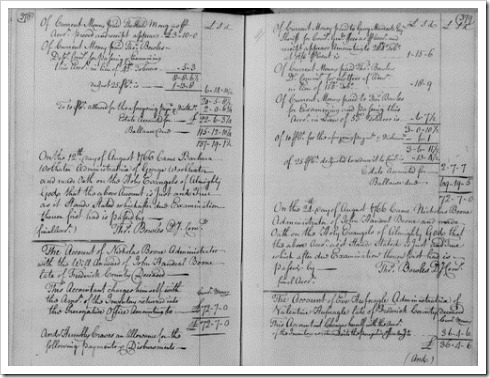
After a little bit of searching, I managed to find two documents.  The first was the administration account, which was dated 24 August 1766.

BOONE, Johann 5067 - 1766 Probate Administration Account

Frederick County, Maryland, Administrators accounts, Book A1, 1750-1767, p. 378-379

Then I found his will, dated 1 November 1761, apparently written before his “voyage to Germany.”  It appears that it was filed(?, or recorded?) on 13 April 1764.

BOONE, Johann 5067 - 1761 Will

Frederick County, Maryland, Will Records, Book A1, 1744-1777, p. 209

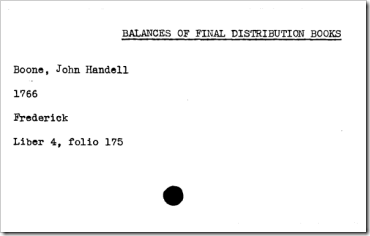
I did not find an inventory, which is odd because it is referred to in the final account from the administrator.  A look through the Probate Records, Colonial, Index, 1634-1777, which are digital images of the index cards through the Maryland State Archives website, shows there is at least one additional record, Balances of Final Distribution, which I assume is referring to the books held by the Prerogative Court. 

balance

And since duplicate records were kept by the county and the Prerogative Court, I’m not sure whether the county has them and they just weren’t filmed by FHL (they’re not digitized or filmed) or if the county lost or destroyed them.  But the FHL does have the Prerogative Court “Balance Books of Estates After Payment to Heirs,” which I’m assuming is what the index card is referring to.

There is another index card labeled “Accounts,” and I assume this is the duplicate held by the Prerogative Court (makes sense since book 55 falls with in the year range).  I gather that it is the duplicate of the the first record I discussed in this post.

accounts

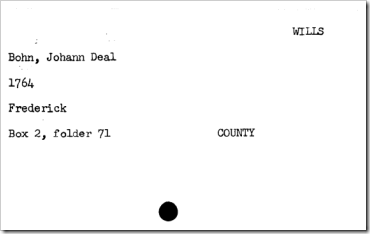
And finally, there is an index card for the will.  However, it does not refer to either the county will books or the Prerogative Court will books.  Instead, it refers to a box and folder at the county level.  Could this be the original will? 

will

So this was a fun little jaunt into a state I’ve never researched and on a person who may or may not be hubby’s eighth great-grandfather.  Certainly a learning experience nonetheless, so I can’t complain.  Clearly more work needs to be done, but for now, I’m happy with what I’ve found and the start I’ve made.  And if this Johann is in fact hubby’s ancestor and was from Germany, it’s nice to know that I’m not the only stubborn German in the household ;)

Genealogy By the States is a theme created by Jim Sanders over at the Hidden Genealogy Nuggets blog.


Share/Bookmark

Saturday, February 16, 2013

Surname Saturday – Garrison (Ontario / Michigan / Illinois)

My earliest known GARRISON is James Manly GARRISON, who was born in Ontario, Canada, in 1861. I'm still trying to determine, with some level of certainty, who his parents are. I know his mother's name was Susan, and I suspect that she herself was a GARRISON, but I need to do some more digging to learn the truth. James and his mother relocated to Detroit, Wayne, Michigan about 1871, and James later moved to Chicago, Cook, Illinois.


First Generation

1. James Manly GARRISON, son of Susan (--?--), was born on 26 December 1861 in Picton, Prince Edward, Ontario, Canada, and died on 23 May 1909 in Chicago, Cook, Illinois. James married Sarah Jane "Jennie" MULLIGAN, daughter of James MULLIGAN and Sarah Norton WEBSTER, on 23 January 1893 in Chicago, Cook, Illinois. Sarah was born on 16 April 1870 in Flint, Genesee, Michigan, and died on 26 April 1947 in Chicago, Cook, Illinois.

Children from this marriage were:
2
i.
James Norton GARRISON was born on 19 September 1895 in Petrolia, Lambton, Ontario, Canada, and died in September 1962 in Ohio. He married Lorene PLATT and they had one child.
3
ii.
Joseph Webster GARRISON was born on 4 January 1898 in Chicago, Cook, Illinois, and died on 23 July 1930 in Chicago, Cook, Illinois. He never married and had no children.
+ 4
iii.
Emma Jane GARRISON was born on 3 November 1901 in Chicago, Cook, Illinois, and died on 20 October 1970 in Elk Grove Village, Cook, Illinois.
5
iv.
Robert Parks GARRISON was born on 12 November 1904 in Illinois and died on 19 December 1984 in Polk County, Florida. He married Florence BOAM and they had one child.

Second Generation

4. Emma Jane GARRISON (James Manly1) was born on 3 November 1901 in Chicago, Cook, Illinois, and died on 20 October 1970 in Elk Grove Village, Cook, Illinois. Emma married John Ward McMAHON, son of Timothy James McMAHON and Sarah Jane WARD, on 26 May 1923 in Chicago, Cook, Illinois. John was born on 7 April 1902 in Chicago, Cook, Illinois, and died on 24 June 1962 in Chicago, Cook, Illinois.

Children from this marriage were:
6
i.
Joan Garrison McMAHON was born on 6 February 1927 in Oak Park, Cook, Illinois, died on 1 March 1980 in Kissimmee, Osceola, Florida, while visiting her uncle Robert GARRISON. She married John “Jack” Francis CAHILL; their only son, Joseph, was my father.
7
ii.
Florence June McMAHON was born on 16 November 1929 in Chicago, Cook, Illinois and died on 17 October 2009 in Big Sandy, Upshur, Texas. She was married three times and had two children.

Disclaimer: Information is based on research completed as of 15 February 2013. Some details have been omitted to protect the privacy of living relatives.

Sources: Available upon request.

PDF Available: The content of this post is available as a PDF through Scribd and may updated periodically as new information is found.

Other Blog Posts: To see other posts about the Garrison family, click here. To see other Surname Saturday posts, click here.

Contact: If you would like more information about this family, or would like to share what you know, please contact me at genblogjulie@gmail.com.


Share/Bookmark

Wednesday, January 30, 2013

Family History Through the Alphabet – Citations

Family-History-Through-the-Alphabet

For 26 weeks I will take you on a family history journey through the alphabet, one letter at a time.  I have decided that each post will be educational in nature, focusing on topics related to resources, methodology, tools, etc.  Although the challenge is complete, there are still some people who are finishing up and Alona, the host, is encouraging others to participate anyway.  Additional information on the challenge, can be found at Take the ‘Family History Through the Alphabet’ Challenge


cThis week I’d like to talk about citations and their importance in genealogy and family history research.  This post is not going to be a crash course in how to cite your sources.  It’s going to be more about the reasons why you should cite your sources, even if you are just a casual genealogist.

In Evidence Explained, Elizabeth Shown Mills defines citations as “statements in which we identify our source or sources for a particular assertion.”1 In other words, when we state a “fact” or draw a “conclusion,” we need to reference the source(s) that led us to that fact or conclusion. For example, if we are looking at a 1900 census that lists a person of interest residing in Chicago, Illinois, that census should be cited as a source for residence fact/event.

Truth be told, when I first started out, I didn’t cite a darn thing.  I borrowed from this or that tree, entered data from compiled genealogies, and stripped the facts from records I had in my possession.  When I started, I just wanted to know how the heck I was related to Noah Webster (the father of the dictionary) and that was it.  I was on a mission and I really didn’t care how I got the answer…I just wanted an answer. 

Then I learned about a little thing called a citation.  This term was not foreign to me as writing and research were a part of my by-day profession.  But for some reason, I never thought to connect that concept with genealogy.  So I began to create “citations” in my handy-dandy genealogy program.  This was before these programs had source writing capabilities based off of Evidence Explained, which at the time I was also oblivious to.  And wouldn’t you know, I wasn’t doing it right.

I’m not talking about structure, or putting commas in the right place.  I mean flat-out, my “citations” didn’t deserve such a term and unfortunately, these crap-tations are still floating around in my database).  I’m serious…they were crap.  I mean “US Census,” seriously?  Sure, I could look at a residence event and figure out which year and place, but beyond that, I had no other identifying information for the census record.  My favorite crap-tation has got to be “Relative’s Obituary.”  That narrows it down, doesn’t it?  And the more I struggled with trying to figure out what record a crap-tation referred, the more I realized that there had to be a better way.

Enter Evidence Explained, the “preferred” method of citing sources in genealogy-land.  Boy did it make a heck of a difference.  As I update those crap-tations periodically, still to this day, I pull out my hair trying to figure which of the five known dead relatives this “Relative’s Obituary” refers to.  I basically had to do the research all over, which in many cases meant re-finding the source and this time obtaining a copy (digital or hardcopy).  The frustration of this ongoing task makes me write proper and coherent citations at the time I enter any data into my database or documents I’m using for evidence analysis purposes.  My sad story alone should be enough to encourage you to start out on the right foot from the beginning (or start now and fix periodically).  But if it hasn’t, I have a few more reasons why it’s important to cite your sources.

As I mentioned earlier, when it comes to citing sources, Evidence Explained is considered the go-to resource for handling the structure of a citation related to genealogy research.  But, it’s not so much about what element goes where and if you use a comma or semi-colon; it’s more about recording enough information about the source to 1) enable others to evaluate the information for themselves, and 2) enable others (and you!) to locate the source.  Let’s look at those two reasons, which will illustrate why citations are important.

Enable Others to Evaluate the Information for Themselves

If you prepare a research article or case study, a book, a website, an online family tree, or even if you just share part of your genealogy database with other researchers, others need to know where you got your information so they can evaluate your assertions.  For example, I’m a little leery of research that only uses derivative sources, such as indexes and abstracts.  This is not to say that these resources are poor quality, but the chance of introducing errors during the indexing or abstracting process is high.  And to be quite frank, these are really considered finding aids to locate the original record.  Granted, sometimes tracking down the original is difficult for various reasons, but you should always try secure it whenever possible.

Additionally, especially when an index is used as a source, there is a greater chance of snatching up the wrong person.  Typically, indexes do not contain enough information to help discern whether you have the right person or not (heck, sometimes the actual record doesn’t contain enough information either!).  So mistaken identity tends to happen when only indexes are consulted.

And before you ask, yes, I myself have cited an index as a resource (and still do under certain circumstances).  Depending on the index, if I feel comfortable that I have the right person, I will put the information in my database and cite the index.  But I also include in the citation notes the finding information, such as volume/page number or certificate number (as an FYI for me, but I suppose it’s helpful to others).  I also add a to-do item to my list to obtain the original.  I cite the index because sometimes I just don’t have access to or the money for the records at that point in time, as I’m sure many of you can relate.  I only do this for what I consider “less critical” research, where I’m not particularly focused on a specific person but some of their details are helpful with the research of someone I am focused on.  If I do become focused on the person, or find that their information is crucial to furthering my research of someone else, then I begin to seek out the originals.  And since I’ve created to-do items that tell me where to get the record and how to locate it, it’s a fairly painless task.

So now that I’ve written a side post about indexes, let me get back to the point.  People need to be able to see what sources you have used for a particular fact/event so they can evaluate for themselves whether they agree with your assertion or feel that additional research may be needed.  If they see a census index being used instead of the actual census record, they may agree with the assertion to an extent, but they may want to follow up themselves with a thorough investigation of the actual census records.  The other reason it’s important for people to see what sources you have used is so they can go to the original to have a look for themselves and/or obtain a copy for their own files.  This of course leads into the next topic…

Enable Others (and You!) to Locate the Source

Many researchers will want to view and/or obtain a copy of the source themselves.  This is not because they don’t trust you, it’s just that they want to give due diligence to their own research.  They want to be able to review the source(s) and draw their own conclusions. 

In other instances, the focus of your research may be on one particular individual, while another researcher is interested in a sibling or another family member.  So they may want to consult the sources you used in order to see what information they might find on the individual they are researching.

And, as I explained in my personal story earlier, you want to be able to find the record again for yourself.  There may be times when you forgot to make a copy of a record or you’ve simply lost or misplaced a record.  If you recorded a citation, you will have no problem obtaining that record again.  But if you didn’t record the source, you may have to traipse through databases, digital images, card catalogs, or finding aids to track down that record again.  For example, let’s say I lost the death certificate for my great-grandfather.  When I look at my list of citation for his death event/fact, I can see that I had gotten the death certificate at the Illinois State Archives, and I even know the death certificate number and which film it was on.  No problem.  I can get that record again, and I didn’t have to search indexes to find the information and then figure out where I could obtain the record—everything was already recorded.

I hope that you can see why it’s important to record your sources, even if you’re just doing genealogy for fun.  Even before I got serious about my research, I had put my tree on Ancestry as a private tree.  I would get emails asking about this person or that person and I had to write back and tell them that I have some information but I have no idea where it came from or if it was even correct…that was embarrassing.  Not only was it embarrassing, I felt terrible that they had wasted their time emailing me and I couldn’t help them.  So, beginner or not, citations are one concept I hope you’ll take to heart.  I promise it will be beneficial to you and others in the long run.

For more information on citing your sources, as well as evidence analysis, I encourage you to purchase a copy of Mill’s book Evidence Explained: Citing History Sources from Artifacts to Cyberspace (yes, it’s pricey, but it’s well worth it).  You can save a little money and purchase the electronic version (I personally like the hard copy, I’ve got notes written all over it and sticky-tabs sticking out from every which way!  But whatever floats your boat, or your pocketbook.)  And don’t forget to check out the Evidence Explained website for more tips—you can even participate in the very-active forum and ask and answer questions related to citations, evidence analysis, and records.

Sources

1.  Elizabeth Shown Mills, Evidence Explained: Citing History Sources from Artifacts to Cyberspace, (Baltimore: Genealogical Publishing Co., 2007), 42.


Share/Bookmark

Saturday, January 26, 2013

Surname Saturday: McMahon (Ireland / Illinois)

My McMAHON line apparently comes from somewhere in County Tipperary, Ireland. Timothy MCMAHON, my third great-grandfather, it the earliest known/proven ancestor in that line. Timothy left Ireland around 1864 and settled in Chicago, Cook, Illinois.  My direct line ancestors are in blue.


First Generation

1. Timothy McMAHON, was born about 1845 in County Tipperary, Ireland, and died on 29 March 1913 in Chicago, Cook, Illinois.  According to his death certificate, his parents were John McMAHON and Rebecca O’BRIEN, both born in Ireland.  Timothy married Margaret RYAN, widow of Edward MURNANE, on 29 June 1873 in Chicago, Cook, Illinois.  Margaret was born about 1846 in County Tipperary, Ireland, and died on 23 July 1928 in Chicago, Cook, Illinois.

Children from this marriage were:
+ 2
i.
Timothy James McMAHON was born on 14 May 1874 in Chicago, Cook, Illinois, and died on 14 October 1939 in Chicago, Cook, Illinois.
3
ii.

John Joseph McMAHON was born on 27 September 1875 in Chicago, Cook, Illinois, and died on 11 September 1937 in Cook County, Illinois.  He never married and had no children.

4
iii.
Ellen "Nellie" G McMAHON was born on 21 January 1882 in Chicago, Cook, Illinois, and died on 14 November 1937 in Chicago, Cook, Illinois.  She never married and had no children.
5
iv.
Jeramiah "Jerry" William McMAHON was born on 8 August 1883 in Chicago, Cook, Illinois and died on 20 February 1928 in Chicago, Cook, Illinois. Jeramiah married first, Florence SHANNON on 23 May 1904 in Chicago, Cook, Illinois.  He married second, Ellen (or Ella) between 1920 and 1928.
6
v.
Elizabeth "Lizzie" V McMAHON was born on 18 June 1886 in Chicago, Cook, Illinois, and died circa 1 October 1955 in Chicago, Cook, Illinois.  Elizabeth married Arthur L FRANCOEUR on 29 June 1937 in Cook County, Illinois.  Arthur was born on 1 November 1889, and died on 3 March 1971 in Miami, Dade, Florida.

Second Generation

2. Timothy James McMAHON was born on 14 May 1874 in Chicago, Cook, Illinois, and died on 14 October 1939 in Chicago, Cook, Illinois.  Timothy married Sarah Jane WARD, daughter of James WARD and Bridget SHEVLIN (may be a married name), on 11 November 1899 in Lake County, Indiana.  Sarah was born on 7 April 1875 in Chicago, Cook, Illinois, and died on 8 October 1956 in Chicago, Cook, Illinois.

Children from this marriage were:
+ 7
i.
John Ward McMAHON was born on 7 April 1902 in Chicago, Cook, Illinois, and died on 24 June 1962 in Chicago, Cook, Illinois.
8
ii.
Timothy G "Thomas" McMAHON was born on 17 March 1904 in Chicago, Cook, Illinois, and died on 10 January 1969 in Cook County, Illinois.  Timothy married first, Nellie Helen FENNEMA, between 1920 and 1927.  Nellie was born 20 March 1903 in Missouri and died on 26 January 1927 in Chicago, Cook, Illinois.  He married second, Eleanor BRANDENBURG, on 30 June 1937 in Cook County, Illinois.  Eleanor was born on 26 March 1910 in Illinois and died on 14 December 1983 in California.

Third Generation

7. John Ward McMAHON was born on 7 April 1902 in Chicago, Cook, Illinois, and died on 24 June 1962 in Chicago, Cook, Illinois.  John married Emma Jane GARRISON, daughter of James Manly GARRISON and Sarah Jane MULLIGAN, on 26 May 1923 in Chicago, Cook, Illinois.  Emma was born on 3 November 1901 in Chicago, Cook, Illinois, and died on 20 October 1970 in Elk Grove Village, Cook, Illinois.

Children from this marriage were:
9
i.
Joan Garrison McMAHON was born on 6 February 1927 in Oak Park, Cook, Illinois, and died on 1 March 1980 in Kissimmee, Osceola, Florida.  She married John “Jack” Francis CAHILL; their only son, Joseph, was my father.
10
ii.
Florence June McMAHON was born on 16 November 1929 in Chicago, Cook, Illinois, and died on 17 October 2009 in Big Sandy, Upshur, Texas.

Disclaimer: Information is based on research completed as of 23 January 2013. Some details have been omitted to protect the privacy of living relatives.

Sources: Available upon request.

PDF Available: The content of this post is available as a PDF through Scribd and may updated periodically as new information is found.

Other Blog Posts: To see other posts about the McMahon family, click here. To see other Surname Saturday posts, click here.

Contact: If you would like more information about this family, or would like to share what you know, please contact me at genblogjulie@gmail.com.


Share/Bookmark

Thursday, January 24, 2013

Genealogy By the States – Week 3 – New Jersey

New Jersey

When I started this post, I really didn’t know if I had any connections to New Jersey.  A quick search of my database pulled up a few events that occurred in New Jersey, one being the birth of my third great-grandaunt’s husband, Vanrancelar Cash VLIET. (Note:  There are many variations on the spelling of his first name, but this is the one I chose.)

According to the book History and Genealogy of the Gov. John Webster Family of Connecticut , Vanrancelar was born on 20 March 1829 at Oxford Township in Warren County, New Jersey.1  The book also lists his parents as “William V. and Martha A. Vliet;” his death certificate, as reported by his son, further states Martha Axford as his mother.2  Beyond this, I had no other information on Vanrancelar or his parents.  So I did a little digging.

There is an index on FamilySearch that has births for New Jersey covering the period I needed, but I didn’t find anything for Vanrancelar, although there were lots of Vliets.  I then proceeded to check out the marriage records on FamilySearch and did find an entry for William VLIET and Martha AXFORD, married on 1 July 1821 in Sussex County, New Jersey.

1-21-2013 10-42-17 PM

Okay, so I’ve confirmed that his parents were married in New Jersey and the county of Sussex neighbors the county of Warren.  So the probability that Vanrancelar was born in New Jersey is looking good. 

As it turns out, William and Martha probably lived in or around the same place when they married (1821) and when Vanrancelar was born (1829) because Warren County was formed from Sussex in 1824.  Some more digging, particularly the 1830 census, heightens this suspicion, as they were probably one of the three William Vliet households living in Independence Township, Warren, New Jersey, a neighboring township to Oxford Township where Vanrancelar was allegedly born.3  (Two of the households that are the most likely are the “William Vliet Jun” household and the “William V Vliet” household.  Without doing extensive research on this family, I don’t know which for sure, but my guess would be the “William V Vliet simply based on the ages and number of children.)

1830UnitedStatesFederalCensus_312807423

This is further supported with the fact that by 1850, the family was living in Independence Township, Oakland, Michigan, which just happens to be named after Independence Township in New Jersey.4 

1850UnitedStatesFederalCensus_312255091

Vanrancelar married my third great-grandaunt, Polly Ann WEBSTER on 24 December 1852 in Pontiac, Oakland, Michigan.5  Polly, daughter of Calvin Price WEBSTER and Betsey PARKS, was born 15 September 1831 and died on 12 March 1910 in Clarkston, Oakland, Michigan.6  Vanrancelar died on 9 March 1915 in Clarkston, Oakland, Michigan.7  They had seven known children:8

  • Eugene (1853-1931)
  • Elmer (1856-1926)
  • Franklin Webster (1858-??)
  • Nettie Elizabeth (1864-1943)
  • Roland Trowbridge (1867-1939)
  • William (1872-1873)
  • Clarence (1876-1971)

Vanrancelar served in the Civil War (Company E, 1st Michigan Infantry) and “was present at the surrender of General Lee.”9


Sources

1.  William Holcomb Webster and Rev. Melville Reuben Webster D. D., History and Genealogy of the Gov. John Webster Family of Connecticut With Numerous Portraits and Illustrations (Rochester, New York: E. R. Andrews Printing Co., 1915), 1362. 

2.  Ibid.  Also, Michigan Department of State, Division of Vital Statistics, death certificate 4 (written), 351 (stamped) (1915), Vanransealor Vliet; digital image, Archives of Michigan, "Death Records, 1897-1920," Seeking Michigan (seekingmichigan.org : accessed September 24, 2010). 

3.  1830 U.S. census population schedule, Independence Township, Warren County, New Jersey, p. 7; digital images, Ancestry (ancestry.com : accessed 21 January 2013); citing National Archives and Records Administration microfilm M19, roll 82.  All three households appear on the same page.

4.  1850 U.S. census, population schedule, Independence, Oakland County, Michigan, p. 33, dwelling 419, family 419, William Vliet; digital images, Ancestry (ancestry.com : accessed 21 January 2013); citing National Archives and Records Administration microfilm M432, roll 360.

5.  Oakland County, Michigan, Marriage Records, 1827-1919, D: 304, Vliet-Webster, 1852; FHL microfilm 973,980. 

6.  Sarah Norton (Webster) (Coffinger) Mulligan, Family Bible Records, 1801-1936, Holy Bible (unknown: unknown, ca. 1850), privately held by Julie Marie Cahill Tarr, [ADDRESS FOR PRIVATE USE], Pekin, Illinois; This Bible belonged to Sarah Norton Webster; it was given to her by her father Calvin Price Webster in 1853.  It is believed that the chain of custody is as follows:  Sarah Norton (Webster) (Coffinger) Mulligan, to Sarah Jane (Mulligan) Garrison, to Emma (Garrison) McMahon, to Joan Garrison (McMahon) Cahill, to Joseph Cahill, to Jean (Miller) Cahill, to Julie (Cahill) Tarr (current owner).  The bible is in critical condition; very frail and falling apart.  Also, Michigan Department of State, Division of Vital Statistics, death certificate 4 (1914), Pollie Ann Vliet; digital image, Archives of Michigan, "Death Records, 1897-1920," Seeking Michigan (www.seekingmichigan.org : accessed September 24, 2010). 

7.  Michigan death certificate 4 (written), 351 (stamped) (1915), Vanransealor Vliet. 

8.  Webster and Webster, History and Genealogy of the Gov. John Webster Family of Connecticut, 1362.  Also, various other records including marriage and death records of the children.

9.  Ibid.

Genealogy By the States is a theme created by Jim Sanders over at the Hidden Genealogy Nuggets blog.


Share/Bookmark

Wednesday, October 24, 2012

Resources for General Genealogy Research

In September, I wrote about my Link Collection to Various Genealogy & History Resources Online. This collection is my Diigo bookmark library targeted at genealogy. I created a list for each state, as well as a few countries and various topics. There is also a list for general genealogy resources. Over the last week or so, I have highlighted some of these lists.  This is the last post in the series. 

general General Genealogy Resources

I currently have over 230 links in this category and am always adding to it.  This list is the catch-all for the resources that don’t really fit into my other categories of location or topic.  Here I’ll share some of my favorites as well as those that are unique.

Newberry Library: Research Guides – Tons of information on research in pretty much every topic you can imagine.  Most guides discuss references that Newberry holds, but many can be found at other research libraries as well.  Many of the guides also point to references outside of Newberry.  If you need to get up to speed on a new topic in your genealogy research, this is the place to start!

Research Outlines – Hosted on the BYU website, these are a must-have resource, especially when you are working in a new state or country.  Reading these guides will help save you time and energy by giving you a solid footing on researching in a particular location.

David Ramsey Map Collection – This “historical map collection has over 33,000 maps and images online. The collection focuses on rare 18th and 19th century North American and South American maps and other cartographic materials. Historic maps of the World, Europe, Asia, and Africa are also represented."

Index to American Genealogies – Published in 1900, this book is an index to American families found in a variety of published materials such as county and town histories, biographies, and historical periodicals.  It is arranged alphabetically by surname.

USGenWeb Project – A group of volunteers provide a website for just about every county in the country.  For each county you might find general information, digital images of records, photographs, transcriptions and abstracts, and other reference materials.

Online Historical Directories Website – A listing of city directories that are available online.  It’s always being updated so make sure to refer to it frequently.

Genealogy Book Links – A central repository (although not exhaustive) of links to genealogies, biographies, and histories online.  Please note that many of the links point to the BYU collection, which I believe is now being hosted by FamilySearch.  Therefore, if a link includes “byu” in the URL, head over to https://books.familysearch.org/ and search for the title of the book and you will be able to access it that way.

Linkpendium – This website is similar to Cyndi’s List with which you are probably familiar.  One thing that makes it a little difference is that it is broken down by state, and then by county.  There are also resources for the UK and Ireland, as well as links related to a particular surname.

List of Online Newspaper Archives – A Wikipedia listing of online resources for newspaper research by country and US state.

American Memory Collection – This is a project of the Library of Congress.  “American Memory provides free and open access through the Internet to written and spoken words, sound recordings, still and moving images, prints, maps, and sheet music that document the American experience. It is a digital record of American history and creativity. These materials, from the collections of the Library of Congress and other institutions, chronicle historical events, people, places, and ideas that continue to shape America, serving the public as a resource for education and lifelong learning.”  There are a variety of topics covered, including Women’s History, Native American History, and Immigration.

Hathi Trust Digital Library – You’ve probably heard of Google Books and Internet Archive, both of which have digitized books available online.  You might not be familiar with Hathi Trust, which is similar.  If you haven’t already, be sure to add this to your list of digital book collections when looking for a family or county history.

Visit General Genealogy Resources for the entire list of general resources, or visit my library to see my entire collection and other lists.

I’m always updating these resources, so be sure to check back regularly. To receive updates to the General Genealogy Resources list, you can subscribe via RSS. You can also subscribe to my entire collection at for updates to all of my lists.

diigo-rss


Share/Bookmark

Tuesday, October 23, 2012

Resources for Genealogy Research in Ireland

In September, I wrote about my Link Collection to Various Genealogy & History Resources Online. This collection is my Diigo bookmark library targeted at genealogy. I created a list for each state, as well as a few countries and various topics. There is also a list for general genealogy resources. Over the next week or so, I will highlight some of these lists.

ireland Irish Genealogy

Irish genealogy can be a little tricky depending on the time period.  Hopefully some of these resources will help you out, as they have for me.

Irish Genealogy Toolkit – A great reference for Irish research.  If you want to get your bearings in Irish genealogy, I recommend you start here.  Provides useful information regarding various records types, if and where they are available, and how to use them.  Also includes a handful of Ireland maps, as well as genealogy forms and charts.

Census of Ireland 1901 & 1911 – Digital images of the 1901 and 1911 censuses are available through the National Archives of Ireland website for free.  Note:  There are multiple pages of the census including a household form, two building forms, and the enumerator's abstract of a street or townland.

Ask About Ireland – Tons of resources including digitized books (they refer to them as eBooks) and informational articles.  Visit the Reading Room for these resources.

IreAtlas Townland Database – Gives you the county, barony, civil parish, poor law union, and province for each townland.  Knowing this information is necessary in order to figure out where to look for a particular record.  If for some reason your search for a townland name doesn’t reveal any matches, run a search on only the county and it will pull up a list for every town in the county.  Sometimes the search is just wonky, other times the town may be listed as a variant of how you thought it was spelled or presented (one word versus two words).

Ireland Genealogy Projects Archives – Various abstracts and transcriptions of records including cemetery, directories, newspapers, and vital records.

Centre for Irish Genealogical and Historical Studies – Various resources for Irish research, including a guide for both researching in the National Archives of Ireland and the General Register Office of Ireland.

Irish Archives Resource – "This web site contains information about archival collections open for public research in Ireland. Its purpose is to aid researchers in finding collections relevant to their studies."

Visit Irish Genealogy for the entire list of Irish resources, or visit my library to see my entire collection and other lists.

I’m always updating these resources, so be sure to check back regularly. To receive updates to the Irish Genealogy list, you can subscribe via RSS. You can also subscribe to my entire collection at for updates to all of my lists.

diigo-rss


Share/Bookmark

Monday, October 22, 2012

Resources for Genealogy Research in Michigan

In September, I wrote about my Link Collection to Various Genealogy & History Resources Online. This collection is my Diigo bookmark library targeted at genealogy. I created a list for each state, as well as a few countries and various topics. There is also a list for general genealogy resources. Over the next week or so, I will highlight some of these lists.

michigan Michigan Genealogy

Michigan is one of my favorites states to research in.  Here are some of the resources is use most frequently.

Seeking Michigan – Digital records from the Archives of Michigan, including death certificates from 1897 to 1920, plat maps, various Civil War resources, and maps.  Several other collections are also available.  Click on Discover in the menu bar to see a listing of all the collections.

Michigan Pioneer and Historical Collections: Research Guide and Digitized Volumes – Volumes 1-40 (1876-1929) of the Michigan Pioneer and Historical Collections are digitized.  These are great resources for Michigan genealogical and historical research.  To access them, click on the Digitized Volumes tab to start.

The Making of Modern Michigan – "The Making of Modern Michigan is a collaborative project involving 52 Michigan libraries.  It includes local history materials from communities around the state.  Michigan's unique heritage is represented through over 4,500 different subjects of photographs, family papers, oral histories, genealogical materials, and much more."

Michigan County Histories and Atlases – Digitized versions of county histories and atlases.  You can browse a particular book, or you can search for a keyword, such as a surname.

Bentley Historical Library at the University of Michigan: Research Tools – A wealth of information related to Michigan research in general, as well as information about the collections.  Be sure to check out the Subject Guide for genealogy.

Michigan Genealogical Council – Includes a listing of Michigan genealogical and historical societies and various research tools.  They also have a really good newsletter that all Michigan researches should be aware of.

Visit Michigan Genealogy for the entire list of Michigan resources, or visit my library to see my entire collection and other lists.

I’m always updating these resources, so be sure to check back regularly. To receive updates to the Michigan Genealogy list, you can subscribe via RSS. You can also subscribe to my entire collection at for updates to all of my lists.

diigo-rss


Share/Bookmark

Friday, October 19, 2012

Resources for Genealogy Research in Connecticut

In September, I wrote about my Link Collection to Various Genealogy & History Resources Online. This collection is my Diigo bookmark library targeted at genealogy. I created a list for each state, as well as a few countries and various topics. There is also a list for general genealogy resources. Over the next week or so, I will highlight some of these lists.

connecticut Connecticut Genealogy

Here are some of the Connecticut resources I use all the time in my own research.

“Connecticut Archives,” 1629-1820 – “The ‘Connecticut Archives’ are the papers and correspondence of the General Assembly, the Governor and Council, and other colony or state officials.  Included in this collection are petitions, drafts of bills, acts, resolves, and other early government documents.”  From this website you can access the indexes to this collection.  To access the actual records, you would need to visit the Connecticut State Library or, in some cases, you could borrow the microfilm from the Family History Library.

Connecticut State Library – Tons of useful information about the library’s holdings as well as information about genealogical and historical research in the state.  Be prepared to spend several hours exploring all the nooks and crannies this website has to offer…seriously!

Society of the Descendants of the Founders of Hartford – This is a lineage society, but their website has a list of Hartford founders, each with a short biography.

Connecticut Genealogy – Thousands of links to various resources for Connecticut research.

The Boundary Disputes of Connecticut – Written by Clarence Winthrop Bowen, this book discusses the boundary disputes with New York, Massachusetts, and Rhode Island.  Also includes several maps.

Connecticut History – Lots of useful information about Connecticut towns.  Most listings offer a short history of the town, photos, and additional resources to consult.  There are also a variety of topics covered, including the Revolutionary War, Invention and Technology, Women, Business and Industry, and Architecture.  They even have information on some famous historical figures such as Harriet Beecher Stowe and Samuel Clemens (a.k.a. Mark Twain).

A Digest of Early Connecticut Probate Records – Three volumes of abstracts from the probate records of the Hartford District for the years 1635 to 1750.  The Digest was compiled by Charles William Manwaring.  Each volume is indexed.  The fact that these books are digitized and available online makes my life a heck of a lot easier when working on Connecticut families in the colonial period.

Visit Connecticut Genealogy for the entire list of Connecticut resources, or visit my library to see my entire collection and other lists.

I’m always updating these resources, so be sure to check back regularly. To receive updates to the Connecticut Genealogy list, you can subscribe via RSS. You can also subscribe to my entire collection at for updates to all of my lists.

diigo-rss


Share/Bookmark

Thursday, October 18, 2012

Resources for Genealogy Research in Luxembourg

In September, I wrote about my Link Collection to Various Genealogy & History Resources Online. This collection is my Diigo bookmark library targeted at genealogy. I created a list for each state, as well as a few countries and various topics. There is also a list for general genealogy resources. Over the next week or so, I will highlight some of these lists.

luxembourg Luxembourg Genealogy

Here are a few of the resources I use frequently when researching my Luxembourg ancestors.

Luxembourg Civil Registrations, 1793-1923 – Digital images of births, marriages, and deaths filmed by the Family History Library in Salt Lake City.  Refer to my post Using Luxembourg Civil Registrations on FamilySearch for more information.

List of Communes of Luxembourg – Great resource from Wikipedia that lists the names of all Luxembourg communes that correspond to a number on a map for geographical reference.

Grand Duchy of Luxembourg Old Postcards – Tons of real-photo postcards of places in Luxembourg.

Research Tools –  Research tools for Luxembourg and France. Includes general information, word lists, town lists, maps, and more. Also information on Alsace Lorraine.

German Word List – Very helpful resource from the FamilySearch Wiki for understanding records written in German.

French Word List – If you are working with Luxembourg records, you will need to know French as well as German, especially the further back in time you go.  This list is also from the FamilySearch Wiki.  It’s not as visually-friendly as the German Word List, but it’s the only one I know of at the moment.

Visit Luxembourg Genealogy for the entire list of Luxembourg resources, or visit my library to see my entire collection and other lists.

I’m always updating these resources, so be sure to check back regularly. To receive updates to the Luxembourg Genealogy list, you can subscribe via RSS. You can also subscribe to my entire collection at for updates to all of my lists.

diigo-rss


Share/Bookmark

Wednesday, October 17, 2012

Resources for Genealogy Research in Iowa

In September, I wrote about my Link Collection to Various Genealogy & History Resources Online.  This collection is my Diigo bookmark library targeted at genealogy.  I created a list for each state, as well as a few countries and various topics.  There is also a list for general genealogy resources.  Over the next week or so, I will highlight some of these lists.

iowa Iowa Genealogy

Following is a list of my favorite Iowa resources.   I use many of them on a regular basis.

Iowa Digital Library – This website is maintained by The University of Iowa Libraries.  There are dozens of digital collections, including Women’s Suffrage in Iowa, Iowa Counties Historical Atlases, Iowa Maps, and Historic Iowa Children’s Diaries.

Iowa WPA Graves Survey – Tombstone transcriptions that were originally collected by the Works Progress Administration in the 1930s.

State Historical Society of Iowa Archive Holdings – Information on the records they have. Also has a death index, by county, for deaths prior to 1935.

Digital Archives of Cedar Rapids Public Library – Free access to digital images of several area newspapers, including Des Moines and Marion, as well as Cedar Rapids city directories and telephone books.

Iowa History Timeline – Good timeline of events relative to Iowa history, from eReference Desk.

Roster and Record of Iowa Soldiers in the War of the Rebellion – Six volumes of books of Iowa regimental histories and soldiers related to the Civil War.

  • Volume 1 - Covers 1st through 8th Infantry Regiments.
  • Volume 2 - Covers 9th through 16th Infantry Regiments.
  • Volume 3 - Covers 17th through 31st Infantry Regiments.
  • Volume 4 - Covers 1st through 9th Calvary Regiments.
  • Volume 5 - Covers 32nd through 48th Infantry Regiments.
  • Volume 6 - Covers miscellaneous organizations of the Mexican War, Indian campaigns, War of the Rebellion and the Spanish-American and Philippine wars; together with historical sketches of volunteer organizations.

Visit Iowa Genealogy for the entire list of Iowa resources, or visit my library to see my entire collection and other lists.

I’m always updating these resources, so be sure to check back regularly.  To receive updates to the Iowa Genealogy list, you can subscribe via RSS.  You can also subscribe to my entire collection at for updates to all of my lists.

diigo-rss


Share/Bookmark

Wednesday, October 10, 2012

Resources for Genealogy Research in Colonial America

In September, I wrote about my Link Collection to Various Genealogy & History Resources Online.  This collection is my Diigo bookmark library targeted at genealogy.  I created a list for each state, as well as a few countries and various topics.  There is also a list for general genealogy resources.  Over the next week or so, I will highlight some of these lists.

mayflower Colonial America Genealogy

These are a few of resources I find helpful for genealogy research in Colonial America.

Society of the Descendants of the Founders of Hartford – Although this is a lineage society, their website has helpful information, including the list of the 163 Hartford founders with short biographies for each.

Cambridge Historical Society – Has some digital collections as well as other resources and finding aids to their archives collection.  Collections cover the colonial period up to the present.

The Founders of the Massachusetts Bay Colony. A Careful Research of the Earliest Records of Many of the Foremost Settlers of the New England Colony – Digitized book available through Internet Archive.

Witches in Colonial America – An article by Kory L. Meyerink, which includes a listing of early-American witches.

New York in the Revolution as Colony and State – Digitized book available through Internet Archive.

The Society of the Descendants of the Signers of the Declaration of Independence – Another lineage society website, this one has information on each of the signers of the Declaration of Independence.

Caleb Johnson's Mayflower History – Includes a list of Mayflower passengers as well as information related to pilgrim history and Mayflower research.

The Plymouth Colony Archive Project – “A collection of fully searchable texts, including: court records, colony laws, seventeenth century journals and memoirs, probate inventories, wills, town plans, maps, and fort plans; research and seminar analyses of numerous topics; biographical profiles of selected colonists; and architectural, archaeological and material culture studies.”

King Philip's War: Based on the Archives and Records of Massachusetts, Plymouth, Rhode Island and Connecticut, and Contemporary Letters and Accounts, with Biographical and Topographical Notes – Digitized book available through Google Books.

Visit Colonial America Genealogy for the entire list of Colonial America resources, or visit my library to see my entire collection and other lists.

I’m always updating these resources, so be sure to check back regularly.  To receive updates to the Colonial America Genealogy list, you can subscribe via RSS.  You can also subscribe to my entire collection at for updates to all of my lists.

diigo-rss


Share/Bookmark

Tuesday, October 9, 2012

Resources for Illinois Genealogy Research

In September, I wrote about my Link Collection to Various Genealogy & History Resources Online.  This collection is my Diigo bookmark library targeted at genealogy.  I created a list for each state, as well as a few countries and various topics.  There is also a list for general genealogy resources.  Over the next week or so, I will highlight some of these lists.

illinois Illinois Genealogy

Here are some of the resources from my Illinois Genealogy list.  Some are ones I use quite frequently and others are simply unique.

Illinois State Archives – Information on the holdings of the Illinois State Archives in Springfield, as well as the Illinois Regional Archives Depositories around the state.  Also has several indexes for various resources.

Abraham Lincoln Presidential Library – Library has tons of genealogical reference materials, not only for Illinois, but across the county.  Also has an extensive newspaper collection of Illinois newspapers.  From their website, you can visit the card catalog, see a listing of newspapers (with dates) in their collection, and take advantage of other genealogy tools.

Illinois Legacy Online – Site is a little temperamental and you need to download a plug-in in order to view the images. Despite those things, there is some pretty neat stuff in the collection, especially if you're researching Abraham Lincoln.

Peoria Historical Society on HistoryPin – The Peoria Historical Society, as of today, has 233 “pins” of historical images on HistoryPin.

Archdiocese of Chicago Archives & Records – Information on the record collections held by the Archdiocese of Chicago.  Also includes a photo gallery.

Illinois Digital Archives – Various digital collections from the Illinois State Library and other Illinois repositories.  Includes photos, newspapers, maps, and manuscripts.

Journal of the Illinois State Historical Society – Digital copies of the ISHS journal from 1950-2006.

Chicago Ancestors – Lots of good information for Chicago research.  Includes map of Catholic churches, map of cemeteries, address conversion tools, and much more!

Illinois Historical Digitization Projects – These are various digitization projects sponsored by Northern Illinois University.

Visit Illinois Genealogy for the entire list of Illinois resources, or visit my library to see my entire collection and other lists.

I’m always updating these resources, so be sure to check back regularly.  To receive updates to the Illinois Genealogy list, you can subscribe via RSS.  You can also subscribe to my entire collection at for updates to all of my lists.

diigo-rss


Share/Bookmark

Wednesday, October 3, 2012

When In Doubt, Map It

Continuing on from My Adventure With Meyers Gazetteer, I was trying to take the information that I learned and develop some sort of research plan.  Unfortunately, I didn’t get very far as I ran into a stumbling block.

Have you ever noticed that some entries in the Family History Library Catalog contain special notes?  For example, in the listing for Zivilstandsregister, 1874-1878, the note explains that these are civil registrations of births, deaths, and marriages for Damsdorf, Pommern, Preußen.  It further goes on to list the other towns that are included in these registers.  Furthermore, it also indicates that Damsdorf is now Niezabyszewo (Bytów), Koszalin, Poland.  That’s a lot of useful information.

More importantly, this added information is helpful when there is no specific location entry for the place you are looking for.  In my case, there is no location entry for Germany, Preußen, Pommern, Bernsdorf, so finding records for this location is a little difficult.  However, noting that Bernsdorf was listed in the notes section of the entry described above, I tried a “keyword” search for Bernsdorf.  There were 15 matches, one of which is the one above.  But there were two other entries related to Pommern that needed to be explored and both were more civil registrations.

The first one was quickly ruled out; the other place names that were included indicated to me (by looking at the gazetteer) that this was a different Bernsdorf altogether.  But the other entry, well there were some place names that were familiar, particularly the civil registration district of Gersdorf.  From my excursion into the Gazetteer, and taking the time to translate it, I recognized Gersdorf and the district government office for Bernsdorf.

Now, I have no idea how this government works or what each “branch” was responsible for.  I also don’t know if you can register, say births, in another location.  But I know enough to question whether the Bernsdorf in this listing is the same Bernsdorf that I’m working with.  So to Google Maps I went!


View this map in Google, which will show each place with its previous and current name.

I already knew from the FHL listing for the Damsdorf registrations, that it was now Niezabyszewo (Bytów), Koszalin, Poland, so I marked it on the map.  The same listing also included the new name of Hygendorf, so on the map it went.  The FHL listing for Gersdorf indicated that it is now Ząbinowice (Bytów), Koszalin, Poland; mapped. 

Through a variety of websites that provided the new names for all of the other towns listed in both FHL catalog entries, I was able to place them all on the map.  I color coded them so I knew which towns were in which batch of civil registrations.  And wouldn’t you know, as I suspected, Bernsdorf is right in the middle (the marker in yellow).  The civil registration office in Gersdorf is about two miles closer to Bernsdorf than Damsdorf, which is the one its assigned to.

Is it possible that some of my family’s records ended up being registered in Gersdorf?  According to the FHL catalog entry there were some from Bernsdorf, so I think it’s worth pursuing.

Had I not first deciphered the gazetteer listing, I would not have recognized the town of Gersdorf.  And, although I suspected a “border” situation, had I not mapped these locations, I would not have known to consider looking in the civil registrations for Gersdorf.  So when in doubt, map it!


Share/Bookmark

  © Copyright 2008~2013. All rights reserved.

  © Blogger template 'Minimalist E' by Ourblogtemplates.com 2008

  Social media icons are from GraphicsFuel.com

Back to TOP  

Related Posts Plugin for WordPress, Blogger...