Picture

Picture

Friday, April 30, 2010

Enhance Document Images for Printing

Sometimes you run across a situation where a digital image of a document is very dark.  This isn’t necessarily a bad thing.  But when you want to print it, that darkness uses a lot of ink or toner.  It coats the paper with so much ink/toner that it’s wasteful and with ink, it can sometimes warp the paper.  Plus, if you want to use the image for publication, it’s nice to have a cleaner version.  Following are instructions on how to make your dark images lighter. 

I use adjustment layers to edit images.  An adjustment layer modifies an image without destroying the original image.  With adjustment layers, you can make modifications, turn them “off” without losing them, or delete them and start over, all without modifying the original image. 

For this particular type of modification, I adjust the Curves of the image.  Curves deal with the tonal range of the image, allowing you to control light and dark areas.  This technique gives you a little more control than using contrast/brightness or levels.  There are various ways to lighten images, but this is the simplest way, especially since we are dealing with black and white documents.

Note:  This technique can be used with most image-editing software, but for this demonstration, I am using Photoshop CS3.

Lighten Up Dark Images

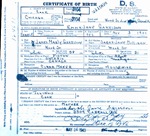
Before

After

Example1 Example2

In the Layer menu, choose New Adjustment Layer, then choose Curves.  In the New Layer pop-up window, click OK.

Menu1

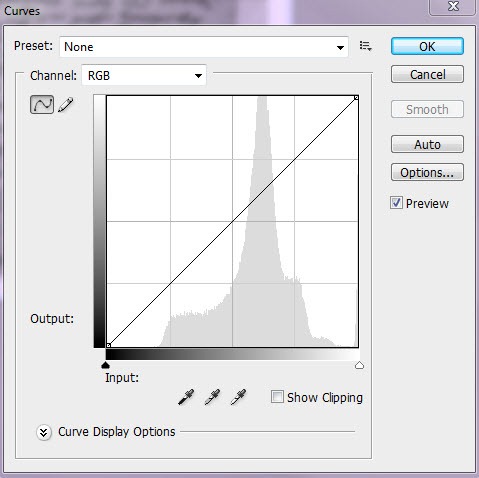
Adjust the curves.  The initial Curves dialog box appears as follows:
Curves1

Note the diagonal line; the bottom-left point represents black, while the top-right point represents white.  Other points can be added along the line to control midtones.  Because we are trying to get as close to a true black and white image as possible, I do not add additional points in the midtone range (this does become important when dealing with photographs).  So for our purposes, we are really only concerned with adjusting the black and white points.  Until you get the hang of it, this can be a bit of guessing game.  Typically though, for our purpose of lightening a dark, black and white image, you want to push the light and dark into the midtone range along the x axis (horizontal).

The resulting adjustment (used for the example image above) is as follows:

Curves2

In this case, I also adjusted the points a little bit along the y axis (vertical).    The result is basically eliminating the gray that covered the original image.

Invert White on Black Images

Another issue we often see is white text on black or a negative image.  For these types of images, we will use the same process above, except we will add another step.

Before

Invert

After

Example3 Example4 Example5

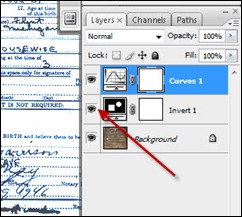
Before you adjust the curves, you need to invert the image.  From the Layer menu, choose New Adjustment Layer, then choose Invert.  In the New Layer pop-up window, click OK

Menu2

Your image is now inverted.  It may be that no further adjustment is needed.  But in the example above, there is a lot of gray, making the image dark.  Continue on by following the steps for Lighten Up Dark Images above.

Saving The Images

You should keep the resulting file, saving it as a Photoshop (.psd) file or a TIFF (.tif) file, either of which includes the original image as well as the adjustments.  This way, if you ever want to make additional changes, or if you need the original image, you have the native file with the original image and the layers.  Do note that this file is much larger than saving it as a JPEG (.jpg) file, but it does maintain the integrity of the original, whereas the JPEG is a compressed file.

Note:  To get back to your original image, simply turn of (uncheck) the layers.

Layers On

Layers Off

LayersOn LayersOff

I hope this helps you with those dark images you have acquired.  I know it saves me a lot of ink!


Share/Bookmark

Research Finds via the Connecticut Archives

Yesterday, I wrote about the Connecticut Archives collection available at the Connecticut State Library.  Today I thought I’d share with you some of the gems I was able to retrieve.

I spent all day Wednesday looking through all of the collection indexes online, looking in particular for my Parks and Webster families (there are many other lines in CT, but these are my focus right now).   Although the collections are held at the Connecticut State Library, many of them are also available through the Family History Library.  There were a bunch of records I wanted, and since everyone was hanging out at the FHL this week, I asked my Facebook friends if anyone could pull a few for me. 

The short list of must-haves initially consisted of 10 films, and about 20 or so records.  Seeing as my research isn’t a priority for someone visiting SLC, I pared it down, creating a must-must-have list of eight records (four films).  Donna Pointkouski, who author’s the blog What’s Past is Prologue, was kind enough to obtain those few records for me.  As for the others, I will deal with them another time (one film has several, so I may order that one the next time I’m at the FHC).

Two collections are of extreme importance, as I am trying to figure out if my seventh great-grandfather, Joseph Parks, actually served in the Revolutionary War.  The DAR has “red-marked” him indicating that the Joseph Parks who served was a younger gentleman; I tend to agree with this.  Joseph’s son, Robert (my sixth great-grandfather), did serve, and it’s possible that Joseph’s son, Joseph, is the other one who served (I have no information on this Joseph at this point, to know whether he was alive at the time of the war, or in the area).  Given Joseph’s age, I thought perhaps he served in the French & Indian War and perhaps King George’s War.

Joseph was indexed in the Revolutionary War Series 1 Index, covering 1763-1789.  The document I had pulled appears to be a petition relating to the reinstating of a tavernkeeper.  Joseph Parks, was one of the signers, as was Robert and John.  I have no idea at this time what this has to do with anything, nor whether it’s my Joseph.  I’m pretty sure that the Robert listed is Joseph’s son.  Both were alive and by all accounts in Voluntown, Connecticut where the document was signed on 5 October 1775.  The only other listing for a Joseph Parks in this index is for a Joseph jr. “priv. Norwich, half days training, 1775.”  Norwich is in the right area of the state, but the indication of “jr.” in the index makes me seriously think this is not my Joseph (mine would have been about 67 years old in 1775).

Moving on to the other collection, Militia Series 1 (1678-1757), there were five documents I had pulled, related to what I believe are Joseph and his father Robert.  The earliest record for Robert in this series is dated 1733, in Voluntown, indicating Lieutenant Robert Parks was from Plainfield.  This seems to line up with other research.  A document dated 1742, includes both a Robert and a Joseph Parks.  Without doing a full analysis, I suspect that Robert in this case, is perhaps Robert’s son, Robert.  A Joseph is found in two other documents, in 1756 and 1757.  In the 1756 document, Lieutenant Joseph Parks was voted Captain of the Eleventh Company in the Eleventh Regiment of the Colony of Connecticut. 

PARKS, Joseph PARKS CT Archive Milita Collection Vol 5 P 370
Connecticut, "Connecticut Archives: Militia records selected papers, series 1-3, 1678-1820," Vol. 5, p. 370; Connecticut State Library, Hartford; FHL microfilm 3,604. 

If Joseph is the same person through all the documents in the Militia Series 1 Collection, it would seem that he was part of the militia in 1742 and perhaps fought during both King George’s War and the French & Indian War.  The next step is to determine if it’s the same person, and if it’s my Joseph.  I also need to obtain the other military documents from the collections.

A very special thanks to Donna Pointkouski for obtaining these records for me.


Share/Bookmark

Friday Finds – 04/30/10

Weekly column sharing genealogy-related things that I’ve learned or found.

Note:  Some of these are from last week, but I forgot to post them.

List of NARA Microfilm Publications and Original Records Digitized by Our Digitization Partners – This is list of records that have been digitized and are available via Ancestry or Footnote, as of March 2010.  They will update the list as more records become digitized.

Preparing for a Genealogy Research Trip – Elyse wrote a great article about getting ready for your next research trip.  She even includes a list of items to bring with you

52 Weeks of Online American Digital Archives and Databases: Iowa – Miriam delivers again in this series, this time focusing on Iowa.  I can’t wait to dig further into these sources for my Linn and Muscatine County families.

Non-Population U.S. Census Schedules Online – Kimberly Powell writes about the non-population schedules (agricultural, industry/manufacturing, and social statistics) that are being added to Ancestry.  She notes, “Not all available schedules are online as of yet. The states covered include California, Illinois, Iowa, Kansas, Maine, Massachusetts, Michigan, Nebraska, New York, North Carolina, South Carolina, Texas, Virginia, and Washington Territory. Some states may have one type of non-population schedule online, but not others.”  Since Michigan was on the list, I spent the better part of the day collecting the agricultural schedules for my folks in Oakland County!

Connecticut Archives, 1629-1820 – According to the Connecticut State Library’s website, “The ‘Connecticut Archives’ are the papers and correspondence of the General Assembly, the Governor and Council, and other colony or state officials. Included in this collection are petitions, drafts of bills, acts, resolves, and other early government documents.”  Most of them are indexed, and the indexes are available online.  More on this is a separate blog post.

The Source:  A Guidebook to American Genealogy – The third edition, edited by Loretto Dennis Szucs and Sandra Hargreaves is available online through the Ancestry.com Wiki.  It’s nice to see this online, as I do not own this book.

Red Book: American State, County, and Town Sources – The third edition of this book, edited by Alice Eichholz, is also available online through the Ancestry.com Wiki.  Although I own this book, it’s nice to have an online version for the times I need it when I’m away from home.

The Federation of Genealogical Societies to Digitize War of 1812 Pension Files – I’ve know about this for awhile now, but keep forgetting to post about it.  Running across Dick Eastman’s post, I figured now was as good a time as any.  The post also includes some general information about the War of 1812 and pension files.  I made three seperate donations:  one in honor of Marsha Hoffman Rising, and the other two for my fifth great-grandfathers who served in the war, Robert Parks and Aaron Webster.

FamilySearch Record Search – Tons of new records available this week!

Historical Register and Dictionary of the United States Army (1789-1903) – This book, by Francis B. Heitman, is available via Google Books.  Various details, particularly about officers.

List of Officers of the Navy of the United States and of the Marine Corps from 1775 to 1900 – This book, edited by Edward W. Callahan, is available via Google Books.


Share/Bookmark

Thursday, April 29, 2010

Connecticut Archives – A Must-See Resource

I’ve been to the Connecticut State Library website a few times before.  But apparently I missed the big-ticket item of the Connecticut Archives.  I had previously viewed the State Archive Finding Aids and other genealogy-related pages, but somehow missed the page with all the online indexes to the Connecticut Archives.

According to their website, the “’Connecticut Archives’ are the papers and correspondence of the General Assembly, the Governor and Council, and other colony or state officials. Included in this collection are petitions, drafts of bills, acts, resolves, and other early government documents.”  The papers are broken down into several topics, such as Colonia Wars, Estates of Deceased Persons, and Towns and Lands.  Some are further broken down into series.  All of the categories have a date range, which falls between 1629 and 1820.

The best part, all of the collections (except one) have an index, which is available online!  I spent all day yesterday looking at all of the indexes that were applicable to my Parks and Webster families (more on that in another post). 

Accessing the Indexes

All of the collections are listed on the Connecticut Archives web page.  Each contains a hyperlink to access the index (except for one, where no index is available, as noted).

In some cases, you’ll get a page with links to the PDF of a volume.  In this case, choose the volume you want on the left, then click on the “Access This Item” link on the right.

Volumes1

Volumes2

When you get one that is by volume, you can scroll down and look under “Descriptions-Table of Contents” to see which volume covers which letters of the alphabet.

Volumes3

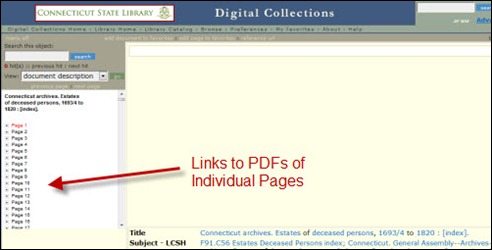
Other times, you’ll get links to PDFs of individual pages.  In this case, it’s a guessing game as to where you end up in the index.  Keep choosing pages until you find what you are looking for.

Pages1

Finding the Records

Now that you’ve (hopefully) found some resources in the index, where do you go for the records?  The Connecticut State Library holds the microfilms of these collections.  (I believe they have all the originals, and if not all, then some, but use is restricted unless the microfilm is not readable.)  Additionally, some are available the the FHL (they are marked by an asterisk (*).

FHL

The best way to find the collections is by doing a Title search in the Library Catalog for “Connecticut Archives" (clicking here will take you to the search results).  Click on the title of the collection you are looking for, click “View Film Notes,” and select the film(s) based on the index entry.

Connecticut State Library

For the collections that are not available through the FHL, it may be possible to get the films through InterLibrary Loan.  Otherwise, you’ll need to visit the library or hire someone to get the records for you.  The CSL does not perform searches or make copies of microfilmed records, but they have a list of genealogists who can help for a fee.


Share/Bookmark

Friday, April 23, 2010

Are You a Fan?

Here is a list of genealogy-related services and products that I’m a fan of on Facebook.  These Facebook Pages are a great way to learn more about a product or service.  Some pages post news and information, special offers, and answer questions posted by consumers.

Allen County Public Library

Ancestry

Association for Gravestone Studies

Casefile Clues

Family Tree Magazine

Footnote

GenealogyBank

Genlighten

National Archives & Records Administration (United States)

National Genealogical Society

New England Historic Genealogical Society

Newberry Library

WorldCat


Share/Bookmark

Have You Joined?

Here is a list of genealogy-related groups that I belong to on Facebook.  Are you a member?  If not, maybe it’s time you joined.  Facebook Groups are a great way to connect with other genealogists.   The groups provide a forum for sharing news and information, asking questions, and helping others.

Cemetery Explorers 

Daughters of the American Revolution (public)

Daughters of the American Revolution (members only)

Find A Grave

Genea-Bloggers

German Genealogy

Illinois Genealogy

International Genealogy

Irish Genealogy

National Genealogical Society

Although I am not a member of the public group for the Sons of the American Revolution, I thought it was worth mentioning.


Share/Bookmark

Friday, April 16, 2010

Friday Finds – 04/16/10

Weekly column sharing genealogy-related things that I’ve learned or found.

Michigan Resources – The Clarke Historical Library has numerous volumes of Michigan history and has a list of holdings broken down by county.  I found this list via the  Midwestern Microhistory blog.

ResourceEnglish Equivalents of Foreign Given Names is a USGenWeb project.  There are lots of names included with derivatives and variation for several languages including French, German, Polish, and Italian.

Illinois Resources – Miriam over at AnceStories has been posting various resources by state each week since the beginning of the year.  This week featured resources for Illinois.  It is a quite impressive list, and even though I know of many of them, she managed to find some I was not aware of.  Great work, Miriam!

Tool – Carol over at iPentimento shares a tool she came across called Directory List and Print.  I’ve been looking for something like this in order to create an inventory of all my digital genealogy files.  Basically, you can pull a list of files in a particular directory and create a Word or Excel document.  The only thing I wish it did was include the file “details” so I could have a complete inventory with file name and description (which includes my source information).  Tip:  If you want to catalog all files within a directory, which also contains sub-directories, but sure to click on the checkbox for “Loop subdirectories.”


Share/Bookmark

Monday, April 12, 2010

This Blog is Ancestor Approved!

ancestor-approved There is a new blog award floating around, and this blog has been honored by David Weller and southwestarkie.  The Ancestor Approved award was created by Leslie Ann Ballou as “a way to let my fellow genealogy bloggers know how much I appreciate and enjoy their blogs full of tips and tricks as well as funny and heartwarming stories”.

The rules of this award state that the recipient list ten things they have learned about any of their ancestors that has surprised, humbled, or enlightened them and then pass the award along to ten other bloggers who they feel are doing their ancestors proud.

As for the ten things I’ve learned, it’s hard to put into words.  I’ve learned so much about my family in the short time I’ve been working on genealogy.  Many of the stories have already been shared here on my blog.  Some stories have yet to be told, simply because I don’t have enough information to tell a well-rounded story.  One of the things that fascinates me is that through my paternal grandmother, I have many ancestors who were pioneers and helped to shape the U.S., from military service to politics.  Many of my ancestors in the other lines immigrated to the U.S. in the late 1800s.  I have yet to learn the reasons why they left their homeland and to what degree of success they had after they immigrated.  These are questions I hope to find the answers to and tell their story.

As for other bloggers doing their ancestors’ proud, here’s my list:

  1. Pam Warren – Granny’s Genealogy
  2. T.K. – Before My Time
  3. Alice Ditts – My Genealogy Research
  4. Tavis Lemaster – TJLGenes: Preserving Our Family History
  5. Brian Zalewski – Zalewski Family Genealogy
  6. Midge Frazel – Granite in My Blood
  7. Becky Wiseman – Kinexxions
  8. George Geder – Geder Genealogy
  9. Amy Coffin – We Tree
  10. Cindy – Everything’s Relative

My other blog, Who Will Tell Their Story?, also received this award.


Share/Bookmark

Sunday, April 11, 2010

Diigo Bookmarks (weekly)


Posted from Diigo. The rest of my favorite links are here.

Share/Bookmark

Sunday, April 4, 2010

Diigo Bookmarks (weekly)


Posted from Diigo. The rest of my favorite links are here.

Share/Bookmark

Friday, April 2, 2010

Friday Finds – 04/02/10

Weekly column sharing genealogy-related things that I’ve learned or found.

Article – The NGS blog informs us of “Massachusetts Senate Bill 820, which will close all vital records after 1841.”

Article – Lorine writes Meaning of Markings on Ships' Passenger List at her blog Ask Olive Tree Genealogy a Question.

NewsNational Genealogical Society has added six additional years of Quarterlies online.  Issues from 1996 to present are available to members online through their website.

Article – Lynn Palmero, the Armchair Genealogist, wrote the post German Genealogy - A Reader Shares Her Tips and Resources.  She shares some helpful tips and resources she got from a reader or her blog.

Article – T. K. posted some information about the Hopkins surname.  First, it’s safe to say that T.K. and I are related through Stephen Hopkins (b. 1634) and his wife Dorcas Bronson (T.K. descends through their daughter Mary, while I descend from their daughter Dorcas).  I’m interest to look at some of the links she provides in this article, particularly the argument about whether this line is related to the Stephen Hopkins of the Mayflower line.


Share/Bookmark

Thursday, April 1, 2010

A Book’s Index Isn’t Always Enough

Most people find a book related to their family or a location their family lived, and immediately look for an index.  If the book has an index, they look for their surname(s), refer to the page(s), make copies (or record the information), and move on.  I myself am guilty of this, especially when time is limited, even though I know indexes are not always complete.

Over the last several days, I have been reading the book, History of Oakland County, Michigan:  A Narrative Account of its Historical Progress, its People, and it Principal Interests, Volume 1, written by Thaddeus D. Seeley, 1912.  I had consulted this book a few times before, mainly performing the aforementioned steps.  But I wanted to learn more about the county so I began reading the book, cover to cover.

Aside from learning more about the area where my ancestors lived, I also discovered there were more mentions of my ancestors than previously found using the index.  Below is a comparison of the indexed entries and the additional references that were not included in the index, for the people I was researching.

Name Index Additional References
Nathaniel Millard 119, 191, 405 236, 404, 412
Samuel Norton 11, 299, 312 342, 365, 366
Frank Norton not included 438
Gad Norton 33, 400 409
John D. Norton 245, 301, 303 224, 265, 304, 307, 360
John M. Norton 58 none found
Calvin C. Parks 124 120, 197
Robert Parks 452 272
Aaron Webster 290, 362 32, 43, 59, 119
Alanson J. Webster not included 225
Charles P. Webster 140 none found
Chester Webster not included 41, 288
Elmer R. Webster 140, 152, 229, 333, 337 none found
James Webster 218 225

As you can see, just in this handful of names, there are many discrepancies.  The lesson learned here is that sometimes, the index isn’t enough.


Share/Bookmark

  © Copyright 2008~2011. All rights reserved.

  © Blogger template 'Minimalist E' by Ourblogtemplates.com 2008

Back to TOP