Picture

Picture
Showing posts with label Education. Show all posts

Thursday, June 27, 2013

Choosing Sessions for a Conference

decisionFiguring out what sessions to attend at a conference can be overwhelming, especially large, multi-day conferences that run several sessions at a time.  So how do you choose what session to attend when everything sounds so good?  And just how do you squeeze in time to visit vendors in the exhibit hall when your schedule is packed with sessions?  In this post, I’ll share my philosophy along with a few other tips along the way.

Choosing a Session

Session selection is based on my educational goals.  At this point in my genealogy research and career, I’m particularly interested in topics that deal with methodology, record sets that I am not familiar with, and locations that I primarily research.   When nothing in a time slot fits that criteria I do one of three things (in this order): a) opt to visit the exhibit hall instead of a session, b) attend a session where the topic is completely foreign to me, even though it isn’t part of my goal (as an example, I don’t research in the South and have no desire to do so, however, I’m always open to learning something new—you never know when you might need it!), or c) attend a session on something I am already familiar with as a refresher and hey, I might learn something new.

Tip:  For sessions that I think may be popular (such as anything presented by Elizabeth Shown Mills and Thomas W. Jones) I really try to get to the session as early as possible.  But I always have a backup session in mind just in case the room is full.

Making Time for the Exhibit Hall

Depending on how much time is between sessions and where the exhibit hall is located in relation to the sessions, I may try to pop into the exhibit hall.  However, I usually find there is not enough time, or I have too much walking to do to get from Point A to Point B and back to Point A.  With my health condition, that’s just not an option.  So, I usually schedule a few blocks of time throughout the conference to visit the exhibit hall.  I also have a plan for the booths I want to check out, which I usually highlight on the exhibit hall map.  Knowing where I want to go helps keep me from wondering around aimlessly and wasting time.

Tip:  Once the list of vendors is announced, I do some pre-investigating and determine if I want to stop by a particular vendor for a visit.  I make a list of those I really want to visit, noting the must-sees.  Whenever a map is available, I highlight the booths I want to visit, using one color for the must-sees and another color for the rest.

Keeping Track of My Schedule

I am a planner by nature.  If you read my previous posts, you know that the minute the schedule for the FGS 2013 Conference was released, I already had the sessions added to my calendar.  Everything gets put into Outlook (because that’s where I manage my life’s schedule!) and is then synced to my phone’s calendar.  Right now, there are no room numbers because that hasn’t been decided yet, but when those are released, I will simply add the location to each calendar entry.  When I’m at the conference, I only need my phone to tell me where I need to be.  And, it will remind me fifteen minutes before the start of a session or event so I know when to get moving.

Tip:  Using Outlook, I have to make sure to put the sessions in at the stated time in the conference location’s time zone.  For example, I am in the Central time zone, but the FGS 2013 Conference takes place in Fort Wayne, Indiana, which is in the Eastern time zone.  So when I add a session to my calendar, that starts at say 3pm, I add it to my calendar in the 3pm time slot but select Eastern as the time zone.  This way, when my computer, phone, tablet, etc. change time zones, my calendar is correct.

Your Turn

How do you choose what sessions to attend at a conference?  Do you plan ahead or wing it?  What about making time for the exhibit hall?  Do you have a strategy, wing it, or do you not visit the exhibit hall at all?  Love to hear from you, so please share your thoughts in the comments of this post!


FGS2013AmbassadorThis post was written for the June/July Ambassador Blogging Prompt as part of the FGS 2013 Conference Ambassador Program. 

If you’d like to be an Ambassador, you can sign up here.


Don’t forget!  The Federation of Genealogical Societies 2013 Conference is quickly approaching.  It will be held from August 21-24 in Fort Wayne, Indiana.  The early registration deadline, which saves you $50 on the cost of the full-conference registration fee ends July 1.  Don’t delay, head over and register now to save!


Share/Bookmark

Wednesday, June 5, 2013

My Itinerary – FGS 2013 in Fort Wayne, Indiana

itinerary

It’s hard to believe the Federation of Genealogical Societies (FGS) 2013 Conference is just a little over two months away!  I’m really looking forward to spending a week in Forth Wayne, Indiana, where I can visit with all my genealogy friends (and hopefully meet some new ones!!), explore the exhibit hall, take in some wonderful lectures, and of course, spend some time at the Allen County Public Library.

I’m a planner by nature.  I like to know what I’m doing and when…I don’t like surprises.  So the minute the conference schedule was announced, I immediately added to my calendar the session I wanted to attend.  There are a few in particular that I think will help me with my genealogy research, especially in places and records that I’m unfamiliar with.  Here are some of those sessions:

Day/Time Session Speaker
Thursday
5pm
Research Reports for Ourselves: More Than a Research Log Paula Stuart-Warren
Friday
8am
Research in the Hawkeye State: Records and Repositories of Iowa Jill Crandell
Friday
11am
Discovering the Past Block-by-Block: Using ChicagoAncestors.org Ginger Frere
Friday
2pm
German Marriage Laws and Customs Warren Bittner
Friday
3:30pm
He Took Her Name: Understanding German Farm Names Teresa McMillin
Friday
5pm
Methods For Identifying the German Origins of American Immigrants Michael Lacopo
Saturday
9:30am
Finding Catholic Church, Cemetery, School and Religious Order Records Lou Szucs
Saturday
2pm
Organizing Evidence to Overcome Record Shortages Thomas Jones
Saturday
3:30pm
Overlooked and Undervalued: Local Government Records in New York State Karen Mauer Green

And of course I have added a few days to the trip so I can spend some time at the Allen County Public Library.  I’ve never been to ACPL so I’m really looking forward to my first visit.  I’m still working on my plan of attack, but fortunately, I had previously added plenty of to-do items to my Legacy database, so a quick filter on ACPL showed a lot of resources I need to check out.  I’ve also been perusing the ACPL card catalog and the Genealogy page for guidance.  Not sure if I’ll break down any brick walls, but you never know what you’ll find until you look!

The FGS 2013 Conference is being held August 21-24 in Fort Wayne, Indiana.  If you haven’t registered for the conference yet, there is still plenty of time to do so and still get the early-bird rate of $190 (ends July 1, after that, the rate increases to $240).  Hope to see you there!!


FGS2013AmbassadorThis post was written for the May/June Ambassador Blogging Prompt as part of the FGS 2013 Conference Ambassador Program. 

If you’d like to be an Ambassador, you can sign up here.


Share/Bookmark

Tuesday, March 5, 2013

Access Archives of Legacy Family Tree Webinars With Monthly or Yearly Membership

Genealogy education on-demand!

I received the following email yesterday announcing a new offering from Legacy Family Tree.  They have created a new website, dedicated to their webinars, and now you can become a member and access any archived webinar (and the handout) at anytime during your membership.  They are offering memberships for an annual fee of $49.95, or you can subscribe monthly for $9.95/month.

The live webinars are still free to attend, and the new website is where you will find information on all upcoming webinars.

Here are more details from Legacy Family Tree.


New Annual/Monthly Webinar Memberships Provide Anytime-Anywhere Access to Entire Webinar Archives and Instructors’ Handouts

LegacyFTWebinars

Genealogists and family historians can now have anytime, anywhere and unlimited access to the nearly 100 recorded genealogy webinars and more than 350 pages of instructors’ handouts that have been part of the Legacy Family Tree Webinar series with our new website at www.FamilyTreeWebinars.com.

Access to the complete archives (over 136 hours of classes) is now available through an annual or monthly Webinar Membership at the introductory price of $49.95 (annually) or $9.95 (monthly). Watching the live, weekly webinars continues to be free (36 more are scheduled in 2013), and visitors are free to view recordings for one week after a live presentation. For Webinar Members, new recordings and handouts will be added monthly at no extra cost.

That’s 1 year of unlimited access for just $49.95.

To take advantage of this special introductory price visit: www.FamilyTreeWebinars.com

A leader in online genealogy education, the Legacy Family Tree Webinar series has been attended by researchers in more than 100 countries. “I’m excited to bring quality genealogy education into the homes of genealogists world-wide,” said Legacy Family Tree Webinars host, Geoff Rasmussen. “Genealogists from the most remote parts of the world have been able to learn from some of genealogy’s  finest instructors because of these webinars. It’s been fun to help pioneer this technology for our industry.”

FamilyTreeWebinars.com currently features 36 of genealogy’s leading educators including Megan Smolenyak, Thomas MacEntee, Barbara Renick, DearMYRTLE, Marian Pierre-Louis, Maureen Taylor, Geoff Rasmussen, Lisa Alzo, and Karen Clifford. Click here for the complete list. Subjects include:

  • Google
  • Organization
  • Photographs & Digital Images
  • Researching in United States, Canada, Ireland, Scotland, England, Germany, Eastern Europe
  • Brick Wall Solutions
  • DNA
  • Genealogy Technology
  • Many more

Register for upcoming webinars for free.

Click here to register for future webinars.

Become a Webinar Member

  • Annual Memberships – introductory price of $49.95/year – complete access to webinar archives and handouts for one year
  • Monthly Memberships – introductory price of $9.95/month – complete access to webinar archives and handouts for one month

Click here to subscribe.


Share/Bookmark

Wednesday, February 27, 2013

Family History Through the Alphabet – Genealogical Standards

Family-History-Through-the-Alphabet

For 26 weeks I will take you on a family history journey through the alphabet, one letter at a time.  I have decided that each post will be educational in nature, focusing on topics related to resources, methodology, tools, etc.  Although the challenge is complete, there are still some people who are finishing up and Alona, the host, is encouraging others to participate anyway.  Additional information on the challenge, can be found at Take the ‘Family History Through the Alphabet’ Challenge


gUntil relatively recently, there wasn’t a truly recognized set of standards for sound genealogical research.  Genealogical research was mainly conducted by principles borrowed from the legal world (primary and secondary sources, preponderance of evidence, and such).

The legal-based principles didn’t really address all the needs or varying scenarios for genealogy research.  Realizing this as an issue, and in order to give genealogical research the proper scholarly footing it deserves, expert genealogists essentially got together and developed a set of “uniform standards” that are “generally accepted” for conducting sound genealogical research.1  These standards are thoroughly documented in The BCG Genealogical Standards Manual.

One result of the development of these standards was the differentiating between a source and the information it provides.  It further goes onto define evidence and how all of these components figure into properly evaluating and analyzing all of the data we accumulate to answer a research question.

Elizabeth Shown Mills puts it best by defining the basic concept of the evidence analysis process as: “Sources give us information from which we select evidence for analysis. A sound conclusion may be considered proof.”2

The terms source, information, and evidence, are further broken down into types, and are thoroughly defined in both the Standards Manual.

  • Source: Original or Derivative
  • Information: Primary or Secondary
  • Evidence: Direct or Indirect

Yet I constantly see these terms misused or improperly defined.  This only confuses the issue and muddles the discussion.  The biggest hang-up is continuing to use the terms “primary source” and “secondary source,” instead of the terms defined in the Standards Manual.  When I’m reading an article or listening to a lecture and hear those terms used incorrectly, I have to stop and think, “are they talking about the source or the information it contains?”  I get myself all confused and that gives me a headache, and I’m cranky when my head hurts.  It also frustrates me because for people who are new to genealogy and don’t know any better, they’re getting contradicting information by the people they trust to learn from, which only perpetuates the situation down the line.

I realize that for people who have been around genealogy for many years it can be hard to use and define the terms set forth in the Standards Manual because for so long the legal terms were used and for most of us, these were the terms we learned in school.  Change is sometimes difficult, I get that.  But as members of the genealogical community, whether you’re a hobbyist, professional, or somewhere in between, we need to take our research seriously and practice our craft by adhering to the genealogical standards that were established. That also means we need to speak the same language, especially when educating others.

I also realize that the genealogical standards continue to evolve as expert genealogists explore new options and considerations, such as dealing with negative evidence and varying classes of derivative sources, including duplicate originals and image copies.3  This is why it is so important to keep up with the goings-on in the genealogical community and participate in educational activities.4

Although I have not been a member of this community for very long, I have heard and read that genealogy was (still is?) the “bad apple” of historical research.  One way to help erase that perception is to follow the genealogical standards in order to produce quality research and to pass on our knowledge to those who share our same passion. 

I really want to see the genealogy field grow and gain the respect it deserves.  And while genealogical standards may seem like a scary and overwhelming subject, designed for the advanced and/or professional researchers, it really isn’t.  These same principles are found in most beginning genealogy books, just in less-intimidating terms. 

Several genealogists took the time and effort to put these genealogical standards together so that we (and the field of genealogy) could all benefit.  We should repay them by incorporating these standards into our own research.  And when we discuss or teach these standards, we should pass down the knowledge of those genealogists by using the terminology correctly, even if that means relearning and/or adapting.

Recommended Reading

To get a good understanding of sources, information, evidence, and their classifications, I recommend the following articles published by Elizabeth Shown Mills on her website Evidence Explained: Historical Analysis, Citations & Source Usage.

To learn more about genealogical standards in general, refer to the following sources:


Sources

1.  The Board for Certification of Genealogists, editor, The BCG Genealogical Standards Manual (Provo, Utah: Ancestry Publishing, 2000), x.

2.  Elizabeth Shown Mills, Evidence Explained: Citing History Sources from Artifacts to Cyberspace, (Baltimore, Maryland: Genealogical Publishing Co., 2007), 24.

3. For an explanation of negative evidence, duplicate originals, and image copies, refer to Evidence Explained, p. 25-30.

4.  For education opportunities, refer to my recent blog post Family History Through the Alphabet – Education.


A special thanks to Dawn Watson, author of the blog Digging in the Roots, for giving me a little push to publish this post and for her review prior to posting.  I started a similar post over a year ago but it was written out of frustration with certain genealogy educators who don’t follow the standards (yet preach to the choir) and misuse and incorrectly define terminology.  Therefore, it has sat in the drafts folder until now.  I completely rewrote it to shift focus away from my frustration and bring it into a more positive and encouraging light.


Share/Bookmark

Wednesday, February 13, 2013

Family History Through the Alphabet – Education

Family-History-Through-the-Alphabet

For 26 weeks I will take you on a family history journey through the alphabet, one letter at a time.  I have decided that each post will be educational in nature, focusing on topics related to resources, methodology, tools, etc.  Although the challenge is complete, there are still some people who are finishing up and Alona, the host, is encouraging others to participate anyway.  Additional information on the challenge, can be found at Take the ‘Family History Through the Alphabet’ Challenge


eEducational opportunities abound in the world of genealogy!  These opportunities have always been around in the form of books, local society programs, conferences, community education programs, etc. But with the advances in technology, there are even more opportunities available.  In this post I will share a variety of educational opportunities that you can take advantage of. 

Books

There are so many books out there on how to research your family history.  From books for beginners, to general genealogy research and practices, to using the internet, to specific topics such as land records and cemeteries—there’s tons!  I wrote about books for the letter B in this challenge, so I’m not going to repeat the same thing here.  Instead, please refer to the post Family History Through the Alphabet – Books.

Genealogical & Historical Societies

societyThese societies are all about preserving the past and educating its members.  Societies can be found at varying levels, such as towns, counties, states, regions, and countries.  Societies offer a variety of educational opportunities, that may include any of the following:

  • Website (may include general information about the location a society covers and/or research databases)
  • Newsletter
  • Journal
  • Blog
  • Meetings and programs
  • Books or other publications for purchase
  • Volunteers (with knowledge and expertise about genealogy in general and/or the location the society covers)

I highly recommend finding a society in your local area where you can attend their programs and meet other genealogists.

Nearly all of the state and national societies (speaking from a U.S. perspective) have an annual conference.  Some are one day, while others are multiple days.  There are usually several different speakers and presentations to choose from, covering a variety of topics.  There are plenty of local societies that also hold small conferences or workshops.  These are usually one-day events and may have one speaker present a few different lectures.  In almost all cases, you do not have to be a member to attend these conferences/workshops.  You may get a discounted rate if you are a member, though.  To learn about what’s coming up around the world, take a peek at a new website called Conference Keepers, which includes all types of events from local society programs to national multi-day conferences. 

Webinars

MP900442327Webinars are live presentations that you can attend via the internet.  They have become very popular in the genealogy community and there are plenty to choose from and many are free to attend.  In some cases a recording of the webinar is available for purchase on CD or as videos to members of the host society.  Here is a listing of the vendors, societies, and individuals who currently provide webinars.

  • Legacy Family Tree – The flagship for genealogy webinars, Legacy Family Tree produces about one webinar a week.  They are free to attend and the recordings are available for free for about 10 days after the live session.  A recording, along with a handout, can be purchased on CD.
  • RootsMagic – These webinars typically focus on using the RootsMagic software, but there are others that cover a variety of genealogy topics.  You can attend the live session for free; recordings are posted for anyone to view at any time.
  • Southern California Genealogical Society – SCGS offers two webinars each month.  They are free to attend live and recordings are available to SCGS members through the members-only section of their website.
  • Illinois State Genealogical Society – ISGS holds one webinar each month and are free for anyone to attend.  Recordings are available to ISGS members through the members-only section of their website.
  • Utah Genealogical Association – UGA hosts one webinar a month, which anyone can attend for free.  Recordings are available to UGA members through the members-only section of their website.
  • Georgia Genealogical Society – GGS holds one webinar each month.  They are free to attend live and recordings are available to GGS members through the members-only section of their website.
  • Friends of the National Archives—Southeast Region – Hosts one webinar each month and are free to attend.  Recordings are available to Friends members through the members-only section of their website.
  • Michael John Neill – Michael offers a variety of webinars that usually cost about $4 to attend.  You can also purchase recordings through his website.
  • DearMYRTLE – Good ol’ Myrt hosts a variety of webinars, which are free to attend.  She even provides recordings of all the recordings here, which can be viewed for free by anyone at anytime.  For upcoming webinars, refer to the GeneaWebinars calendar.
  • Looking4Ancestors – Kathryn Lake Hogan produces webinars periodically, which are free to attend.  Recordings can be purchased through her website.  For upcoming webinars, refer to the GeneaWebinars calendar.

In addition, you can also check out GeneaWebinars, which is a blog and calendar of upcoming webinars.

Higher Education and Continuing Education Programs

MP900411749I only know of three programs that fall into this category (if you know of others, please share them in the comments of this post).  There is one formal program, that offers a traditional degree.  The other two are considered “continuing education” programs that are affiliated with a university and offer a certificate program.  You might also find courses or certificate programs offered at a community college in your area.

  • Brigham Young University – Earn a Bachelor’s degree in Family History.  A minor and certificate program are also available.
  • National Institutes for Genealogical Studies – Online educational opportunity that offers various certificate programs in genealogy.  With the successful completion of a certificate program, you are awarded the postnomial PLCGS (Professional Learning Certificate in Genealogical Studies).  NIGS is affiliated with the Continuing Education Division of the University of St. Michael's College in the University of Toronto.
  • Boston University – Offers a certificate program in Genealogical Research, which is a 15-week online program.  Also offers a 4-week Genealogical Essentials course.

Institutes

MP900405166Institutes are an intense, week-long, hands-on learning experience.  Instructors are experienced researchers who a prominent in the genealogical community.  Typically, there are several tracks to choose from, picking one that you follow throughout the week.  Below are links to the various institutes.

National Genealogical Society Education

MC900439254The National Genealogical Society offers a variety of educational opportunities.  All are available to members and non-members, except for the Family History Skills, which is only available to members for free.  Below are all of the current offerings from NGS:

  • NGS American Genealogy: Home Study Course – This is a multi-lesson course available via CD.  It’s a comprehensive, hands-on learning experience (you can view the detailed syllabus here).  Assignments are submitted and feedback is provided for each.  Once you complete all three CDs, you will receive a certificate of completion.
  • Family History Skills – Free to NGS members, designed for those who are new to genealogy or need a refresher.
  • PDF Courses – There are a handful of PDF courses available, currently including Genetic Genealogy, the Basics, Introduction to Civil War Records, and Working With Deeds.
  • Online Courses – These are interactive courses that are conducted online.  Currently, there are two course available:  Special Federal Census Schedules and Transcribing, Extracting, and Abstracting Genealogical Records.

Social Media Networking

MC900341835I hate to say it, but if you’re not participating in some form of social media, you’re missing out on a great education opportunity that’s completely free.  Some people are on every social media network available, but the three that I think are most important to the genealogist, in terms of education, are Facebook, Google+, and Twitter.

It’s amazing what you can learn from a 140-character tweet on Twitter, when following others who are interested in genealogy and history.  In the last 20 minutes, I saw some of the following tweets:

Facebook and Google+ are very similar, but with different terminology.  In Facebook, you are “friends” with people, while with Google+ you have people in your “circles.”  In Facebook, you can join “groups,” in Google+, they’re “communities.”  Whichever network you prefer, the idea is the same, to connect with people, be it family, friends, colleagues, or people who share your interests (such as genealogy!).  And be sure to join groups/communities related to genealogy.  This is a great place to learn, as well as get to know other genealogists.  Here are some groups you might be interested in:

Facebook Groups Google+ Communities

You should also consider following genealogy businesses and societies, or other genealogy-related pages, to keep up-to-date on genealogy news.  Here are some you might like to follow:

Facebook Pages Google+ Pages

Miscellaneous

Businesswoman typing.The following educational opportunities don’t fit into any specific category above, but are just as important.

  • YouTube – There are tons of videos on YouTube about genealogy and history.  If you head over to my YouTube channel, you can see a list of my favorite channels.
  • Family Tree University – Education in the form of online courses, independent study courses, and webinars.  There is a cost associated with each.
  • FamilySearch Learning Center – Hundreds of educational videos covering oodles of topics. Watch and learn at your leisure, for free.
  • FamilySearch Research Wiki – A great place to look for information about researching a particular location or record type.
  • Free Online Courses from BYU Independent Study – Various genealogy and family history topics, as well as a variety of other non-genealogy topics including gardening and personal finance.

The Wrap-Up

I hope you’ve found some ideas for seeking out different educational opportunities.  I tried to cover a variety of outlets in hopes that you’ll find one or two that suit your needs.  If you have ideas you’d like to share, please do leave a comment!


Share/Bookmark

Thursday, January 31, 2013

Genealogy By the States – Week 4 – Georgia

Georgia

I don’t have much connection to Georgia, so this week I thought I’d share something that’s a little new to me and talk about the Georgia Genealogical Society.  It’s not that I’d never heard of this society, it’s just that until recently, I didn’t know what they were up to.

GGSThe Georgia Genealogical Society (GGS) seems to be one of a few state genealogical societies that is jumping into the 21st century and embracing new technologies and finding innovative ways to reach their members and provide valuable services.  About a month ago I discovered that like Southern California Genealogical Society, Utah Genealogical Association, and Illinois State Genealogical Society, GGS is offering monthly webinars as a form of education for the members and the genealogy community as a whole.  This is a great way to reach out to members who live beyond the borders of Georgia.  The GGS webinars are free to the public when they are broadcast live and GGS members have access to the recordings through the members-only section of the GGS website.  Visit the GGS webinar calendar to see what’s planned for 2013.

And while I was on the GGS website to see what webinars they were offering, I also noticed that they have a members-only section that contains a variety of resources including Index to Georgia's Federal Naturalization Records to 1950 (Excluding Military Petitions) and digital copies of the first 20 years of their quarterly journal, as well as some other resources.

They’ve even embraced social media tools such as Facebook and Twitter to broaden their outreach to the genealogical community and a new generation of genealogists.  And of course, just like most state societies, GGS provides members with a quarterly journal, as well as a quarterly newsletter.  Their newsletter is digital and appears to be available to non-members as well (just click cancel when the login pops up).

It’s nice to see a state society thinking outside the box and finding was to provide valuable services to its members!

Side Note:  Okay, so I wasn’t going to write about my crazy Rottman family for this post because I already covered them in the Pennsylvania post two weeks ago and will be covering them in this week’s Surname Saturday post.  But, on a whim, after completing this post, I decided to head over and see what was new at FamilySearch for the state of Georgia.  And while the Georgia, Births and Christenings, 1754-1960 database wasn’t exactly new, it was new to me, so I figured I’d give it a go since one of the children was supposedly born in Henry Co. Georgia.  And boy did I find something.  You can read about here.

Genealogy By the States is a theme created by Jim Sanders over at the Hidden Genealogy Nuggets blog.


Share/Bookmark

Wednesday, January 23, 2013

Family History Through the Alphabet – Books

Family-History-Through-the-Alphabet

For 26 weeks I will take you on a family history journey through the alphabet, one letter at a time.  I have decided that each post will be educational in nature, focusing on topics related to resources, methodology, tools, etc.  Although the challenge is complete, there are still some people who are finishing up and Alona, the host, is encouraging others to participate anyway.  Additional information on the challenge, can be found at Take the ‘Family History Through the Alphabet’ Challenge


bBooks are important in genealogy for several reasons.  First, they are a source of education on the subject of genealogy and its many subtopics.  Then of course there are the research-related books that include indexes to records, transcripts and abstracts of records, family histories and compiled genealogies, as well as books related to history (e.g., general history about a country, region, state, county, or town; historical events, such as a war; or a time period, such as The Great Depression).  In this post, I’ll share a list of genealogy references I recommend, how to find research-related books, and a few other tips along the way.

The Genealogist’s Reference Shelf

The following seven books are must-haves for anyone with an interest in genealogy research.  Between these seven books, you will learn tips and techniques for general genealogy research and analysis, how to find and use various record types, and how to deal with documentation, from collecting to abstracting to citations.

The books below are also great references for specific genealogical topics.

In addition to these resources, there are plenty of books available on other topics, including ethnic research (e.g., German, Irish, etc.). 

And while books are still a great source of information, many publishers are turning to short reference guides on a specific topic.

For a listing of some other reference books, check out my Goodreads Genealogy General Reference list.

Finding Research-Related Books

There are so many books out there that contain transcripts and abstracts of records, as well as indexes to records.  Also of use to the genealogist are compiled genealogies and family histories and the various history books as I described above.  These books are often hard to find and many times are hidden among genealogy or local history collections in public and society libraries.  Fortunately, the internet has made finding these books a little easier.  Here are a few ideas to help you find these gems.

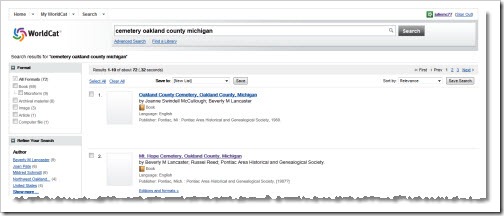
WorldCatWorldCat is a online catalog of collections from participating libraries.  It’s a good place to search for books to see what’s available.  Each book listing provides a list of libraries that have that book in their collection.  Here’s an example.  Let’s say I want to see if there are books that contain cemetery records for Oakland County, Michigan.  I used the search string cemetery oakland county michigan and found 72 results.
WC1

The second entry is for Mt. Hope Cemetery, which is a cemetery of interest.  When I look at the listing for the book, I can see what libraries near me have the book. 

WC2

Unfortunately, the nearest library is 138 miles away. But if one of these libraries circulates this book, I may be able to get it through inter-library loan at my local library. The listing also tells me the publisher of the book, which happens to be the Pontiac Area Historical and Genealogical Society.  I may be able to contact them and see if they have the book available for sale. 

If I found a book that had been published prior to 1923, I would try to see if I could find a digitized copy through Internet Archive, Google Books, or HathiTrust (more on these sites in a few moments).  Or I might see if I could find a used copy to purchase from websites like Amazon, eBay and Half.

The other nice thing about WorldCat is that you can create an account and save books of interest to your account (you can even create lists to categorize your books, for an example, you can view my profile page here).

Genealogical and Historical Societies – Many research-related books, especially the books that are indexes to records or that contain transcripts or abstracts of records, are compiled and published by genealogical and historical societies in the interest of preserving records and history.

Let’s say that I do extensive research across the state of Colorado.  I might check out the Colorado Genealogical Society website to see what publications they have that may help me in my research.  If I find something of interest, I could do one of a few things:

  • Purchase the book from the society.
  • Search WorldCat (discussed above) and see if I can get the book from a nearby library or through inter-library loan.
  • Search for a used copy to purchase.  (Note:  While I’m all for supporting genealogical and historical societies by purchasing their books, sometimes I simply cannot afford the price tag.)

Don’t forget the check out national, regional, state, county, and town societies to see what books the may have published.  If they don’t have a website, call or email them.  They should have a listing of publications that are for sale, even if they have to send it to you via snail mail.

Internet Archive, Google Books, and HathiTrust – These websites contain digitized copies of books that are no longer under copyright.  Their scope is very broad, meaning that the digitized books cover more than genealogy and history.  While you certainly can find books by using keywords, I find that it’s usually better to have a title to search on.  But, absent a specific title and looking for books on the history of Ontario County, New York, I searched on the string ontario county new york history on each of the websites.

On HathiTrust I received four results.  The first one certainly looks promising.

Hathi1

On Google Books, using the same string ontario county new york history, I received 262,000 results, although the first three on the list were very relevant.  A modified search string of "ontario county" and "new york" and history narrowed it down to 45,100 results.  Like with any Google search, you may need to play around with search terms to narrow the field to the most relevant results.

GB1

Also, keep in mind that Google Books contains information on non-digitized books in addition to those they have digitized, so it’s also good for finding books on a subject, even if it’s not digitized.  And, if you are a Google user, you can create bookshelves and save the books you find.

On Internet Archive, using the original search string of ontario county new york history, I received 16 results.  All look promising, but there are duplicates (this happens when more than one institution digitizes the same book).

IA1

Family History Books – If I remember correctly, this project used to be hosted through Brigham Young University.  Family History Books is now available through FamilySearch and continues to grow by leaps and bounds having now partnered with institutions beyond BYU and the Family History Library.  Unlike the three website we just discussed, this website contains digitized books specific to family history.  The collection includes compiled genealogies, county and local histories, gazetteers, and even genealogy magazines and how-to books.

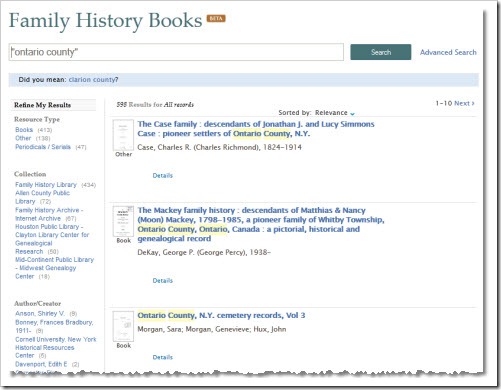
Using the same search for books related to the history of Ontario County, New York, I used the same general search string ontario county new york history and received 6,705 results.  Many of the results seemed irrelevant.  So I tried using quotation marks and the word and (then the + sign) and while the results narrowed down considerably, there was still a lot of irrelevant results.  So I used the search string “ontario county” and came up with 598 results.  This of course broadened it beyond a county history, but the results were at least centered on Ontario County (in and out of New York).  The website is in Beta, so maybe there will be some improvements to the search in the future. 
FHB1

I did try the advanced search once I was able to get an idea of how the subjects were constructed (originally my subject searches were going nowhere).  That narrowed down the pool considerably to any subject that contained “New York, Ontario.”  I wish it was set up like the FHL card catalog; I think that would make finding things much easier, but perhaps I just haven’t played around with it enough.

FHB2

Search Engines – Another way to find book titles is to do an internet search using your favorite search engine.  For example, I wanted to see what books exist for the War of 1812.  I’m looking for general references to learn more about the war itself, not tied to anything in particular, so I used the search string “war of 1812” book

Google

While my Google search returned books for sale at Amazon and those digitized by Google (or others), there were some interesting search results.  One of the first ones was an article in the Washington Post that talked about three different books on the subject.  I also found a War of 1812 website that had a listing of several books, with links to the Amazon descriptions, as well as reviews.

Where to Purchase Books

Popular books, such as genealogy “how-to” books, can be purchased through many retailers both online and at the brick and mortar stores.  My favorites are Amazon and Barnes and Noble.

Genealogical Publishing Co. specializes in genealogy and history books.  In some cases these books are new or recently published books, while other times they are reprints of those previously-out-of-print books such as compiled genealogies.

For hard-to-find or out-of-print books, used copies may be the only way to go.  You can purchased used books through Amazon, eBay, and Half.  I like Half because I can set up a wish list and I will be notified by email when a book is posted for sale.  I can usually find a good deal this way.  With eBay you can save your searches and get notified by email when a new item matching your search becomes available.

And don’t forget the genealogical and historical societies we discussed above!

One Final Tip

Several months ago, I was introduced to a website called Goodreads.  It’s similar to a website that I was previously familiar with called LibraryThing.  While I joined LibraryThing, I didn’t really get into it and never invested the time in it.  Things may have changed in the last few years since I visited it, so it may be something you’d like to explore.

Anyway, I really got into Goodreads.  I found it very easy to keep track of my own book inventory, as well as books that I want to read but do not own (for instance I have tags for where I can obtain the book such as Amazon or the library).  I also get to keep track of the progress I make on a book I’m reading, as well as provide a rating and a review when I’m finished.  Keeping an inventory also helps me to not buy a book I already own (or borrowed from a library and read), which I have done in the past.

But the best thing I’ve found is that I can see what my friends are reading (or want to read).  I get to see how they rated a book and what they thought of the book if they provided a review.  I’ve discovered several genealogy-related books that I may not have otherwise found, and I can quickly add them to my “Want to Read” list.

I’m still working on getting my inventory logged.  It takes some time, but I do a little bit each day.  And I also created tags so I know if I own the hardcopy, the Kindle version, or a PDF (such as those I’ve downloaded from Internet Archive and Google Books).  This way I know what I have and more importantly, where it is!

If you are using Goodreads and we are not friends already, feel free to friend me.  Same goes for those who decide to start using the site in the future.  Earlier in this post I provided a link to my Genealogy General Reference book list; you do not have to be a Goodreads member to view it.  You can visit my profile and peruse all of my bookshelves, but here are a few links to my genealogy-related shelves in case you’re interested.

I hope you got some good ideas and tips from this blog post.  If you have ideas you’d like to share, I'd love to hear them, so drop me a comment!


Share/Bookmark

Wednesday, January 2, 2013

Legacy Family Tree Releases Their 2013 Webinar Schedule

webinarlogo

Last week, while I was out of town, Legacy Family Tree announced its lineup of 2013 webinars.  There are plenty of topics to choose from, across all skill levels.  Here are a few that I am really looking forward to attending:

I’ve already signed up for all the webinars I want to attend.  This way, they are on my calendar in advance and I can plan accordingly, especially for those I don’t want to miss!


Share/Bookmark

Friday, December 14, 2012

Illinois State Genealogical Society Announces Its 2013 Webinar Series

ISGS Webinar Logo

Earlier today, the Illinois State Genealogical Society (ISGS) announced that registration is now open for the 2013 Webinar series!  This year’s lineup has something for everyone, from beginners to experts, and everyone in between.

Webinars are a fantastic way for genealogists to learn more about research, methodology, records, and more.  ISGS offers the live broadcast of their webinars to the public for free on the second Tuesday of each month at 8:00 PM Central.  ISGS members have access to all the webinar recordings after they’re presented live.

As the Education Committee Chair for ISGS, I will be attending all of the webinars.  I’m looking forward to each and every one, but I am especially excited about a few in particular.

Timelines: Placing Your Heritage in Historical Perspective with Laura Prescott on May 14.  I love Laura, she’s a fantastic speaker and I always learn a lot from her presentations.  And, I love timelines, so any new tips I can pick up is a bonus.

The Research Calendar: A Resource You Cannot Live Without with Luana Darby on June 11.  Many people have requested this topic and I can understand why.  This is definitely something I struggle with, so I look forward to Luana’s tips.

“To the Honorable, the General Assembly” - The Treasure Trove in Legislative Petitions with Judy G. Russell on September 10.  Judy is a wonderful speaker and I am so glad she agreed to do a webinar for ISGS.  It’s an interesting topic and I think it will open people up to a source that may be unfamiliar to them.

Visit Upcoming Webinars to see the entire 2013 schedule and sign up.  Don’t delay!  Get them on your calendar right away!  (LOL, that rhymed)


Share/Bookmark

Wednesday, December 12, 2012

Southern California Genealogical Society Announces 2013 Webinar Series

SCGS2013

I received an email yesterday, from the Southern California Genealogical Society (SCGS), informing me that registration for the 2013 Jamboree Extension Webinar Series is now open.  SCGS holds two live webinars each month and they have a great lineup for 2013. 

The live sessions are free and open to the public.  As an added benefit to SCGS members, recordings of the webinars are available to them through the members-only section of their website.

Be sure to check out the whole list and register.  I like to register early and have them on my calendar so I can plan around the ones I really don’t want to miss.


Share/Bookmark

  © Copyright 2008~2013. All rights reserved.

  © Blogger template 'Minimalist E' by Ourblogtemplates.com 2008

  Social media icons are from GraphicsFuel.com

Back to TOP  

Related Posts Plugin for WordPress, Blogger...